Louise Ann Wilson's journal articles develop ideas arising from her creative practice and practice-led research. Published in peer-reviewed journals and monograph series, they explore landscape, walking, scenography, health, memory, materiality and socially engaged performance through critical reflection and creative enquiry.
Recent Publications
-
Wilson, Louise Ann (2026). 'Emplacing and Walking the Menopause'. In Reimagining Menopause. Edited by Shani Orgad, Belinda Steffan and Odessa Hamilton. The Sociological Review Monograph, Vol. 74, No. 4.
Selected Earlier Articles
-
Wilson, Louise Ann (2023). 'Lockdown in Lancaster and Morecambe: Walk, Run, Pedal, Push'. In Kaya Barry and Jen Southern (eds.), Mobilities. Special Issue: An Agenda for Creative Practice in the New Mobilities Paradigm.
-
Wilson, Louise Ann (2019). 'Dorothy Wordsworth's Legacy: A "Feminine" (Material) Sublime Approach to the Creation of Applied and Socially Engaged Scenography in Mountainous Landscapes'. In Jonathan Pitches and David Shearing (eds.), Performance Research, 24(2), On Mountains.
-
Wilson, Louise Ann (2017). 'Creating Warnscale: Applying Dorothy Wordsworth's Mode of the Feminine Sublime to a Walking-Performance about In/Fertility and Childlessness'. Language, Landscape and the Sublime. art.earth.
-
Wilson, Louise Ann (2015). 'Warnscale: A Landmark Walk Reflecting on In/Fertility and Childlessness'. Journal of Fertility Counselling, 22(3), pp. 24–28.
-
Wilson, Louise Ann (2015). 'Warnscale: A Landmark Walking-Performance'. Blue Pages. London: Society of British Theatre Designers, pp. 8–9.
Enlarge image
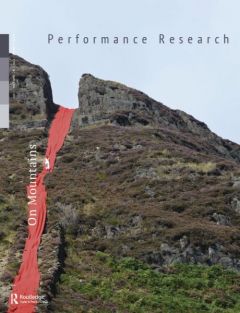
In this article, I argue that a feminine 'material' sublime approach to mountains exists, and has done for generations, yet remains under-recognised and on the fringes of mainstream discourse, which—historically and in the present—has been dominated by masculine 'transcendent' sublime accounts, encounters and endeavours.
The article explores how, during the Early Romantic period, the concept of the masculine transcendent sublime—an intellectual and spiritual experience that transcends physical matter—came to dominate ways of understanding landscape. In contrast, I propose the feminine material sublime as one that is located in, and present to, the physical landscape: not as a place from which to escape or disappear, but as a place in which to reappear. I suggest that this mode of engagement is both transformative and therapeutic.
Drawing on the landscape writing of Dorothy Wordsworth and her female contemporaries, I explore how their attentive ways of walking and observing landscape reveal a feminine material sublime that brings into view everyday objects, people and experiences that are often overlooked or remain at the edges of mainstream social and cultural discourse.
The article also examines how these ideas have informed my own creative practice and the development of a model for creating applied and socially engaged scenography through site-specific walking-performance. Central to this model are the Seven Scenographic Principles, which are discussed through a number of projects, including The Gathering / Yr Helfa (2014), Warnscale: A Land Mark Walk Reflecting on In/Fertility and Childlessness (2015), and Dorothy's Room and Women's Walks to Remember: "With memory I was there" (2018).
Related Projects
The Gathering / Yr Helfa
Warnscale
Dorothy's Room and Women's Walks to Remember
Sites of Transformation
In this article, I argue that a feminine 'material' sublime approach to mountains exists, and has done for generations, yet remains under-recognised and on the fringes of mainstream discourse, which—historically and in the present—has been dominated by masculine 'transcendent' sublime accounts, encounters and endeavours.
The article explores how, during the Early Romantic period, the concept of the masculine transcendent sublime—an intellectual and spiritual experience that transcends physical matter—came to dominate ways of understanding landscape. In contrast, I propose the feminine material sublime as one that is located in, and present to, the physical landscape: not as a place from which to escape or disappear, but as a place in which to reappear. I suggest that this mode of engagement is both transformative and therapeutic.
Drawing on the landscape writing of Dorothy Wordsworth and her female contemporaries, I explore how their attentive ways of walking and observing landscape reveal a feminine material sublime that brings into view everyday objects, people and experiences that are often overlooked or remain at the edges of mainstream social and cultural discourse.
The article also examines how these ideas have informed my own creative practice and the development of a model for creating applied and socially engaged scenography through site-specific walking-performance. Central to this model are the Seven Scenographic Principles, which are discussed through a number of projects, including The Gathering / Yr Helfa (2014), Warnscale: A Land Mark Walk Reflecting on In/Fertility and Childlessness (2015), and Dorothy's Room and Women's Walks to Remember: "With memory I was there" (2018).
Related Projects
The Gathering / Yr Helfa
Warnscale
Dorothy's Room and Women's Walks to Remember
Sites of Transformation