
Walks to Remember During a Pandemic
Walks to Remember During a Pandemic was inspired by a series of 'surrogate' walking projects in which I re-walked walks that people could no longer undertake but longed to do—a process that involved participants drawing a memory-map. One of these projects, Women's Walks to Remember, was itself inspired by Dorothy's Room, a project exploring Dorothy Wordsworth's later life at Rydal Mount, when illness left her largely confined to her bedroom and increasingly reliant on memory to transport her into landscapes she had once walked. Dorothy's Room drew on Wordsworth's Rydal journal and her poem Thoughts on my Sick-Bed, in which she writes:
'No need of motion, or of strength,
Or even the breathing air:
I thought of Nature's loveliest scenes;
And with Memory I was there...'
Methodology
During the project, participants were invited to create a memory-map of a walk they were unable to undertake because of the Covid-19 restrictions. Rather than focusing on producing a finished drawing, the emphasis was on the act of remembering. Through memory, participants were encouraged to revisit landscapes they could no longer physically reach.
Memory-mapping could be undertaken individually or with others, in person or at a distance. Participants used words, lines, symbols and images to record remembered routes, stopping places, activities, sounds, smells and significant moments.
Credits
Created by Louise Ann Wilson
With contributions from participants in the UK and internationally
Memory-Mapping Prompts
Participants were invited to reflect on questions such as:
-
Where (place, region or country) is your walk to remember?
-
Where does your walk begin and end, and what route does it follow?
-
When and how often do you walk this walk?
-
Is there a particular reason or purpose for the walk?
-
Do you walk alone or with others?
-
Are there particular features or stopping places that are important?
-
Are there actions, activities or jobs associated with the walk?
-
What sights, sounds and smells do you remember?
-
Do you have photographs connected with the walk?
Memory-maps could take many forms. They included spring or winter walks; garden walks; everyday local walks; distant walks; family walks; friendship walks; solitary walks; pilgrimages; therapeutic walks; childhood walks; work-related walks; imagined walks, and many others.
Participants used words, lines, symbols and drawings to record remembered routes, stopping places, viewpoints, picnic places, swimming places, sleeping places, recovery places, gathering places and other locations that remained significant in memory.
The Memory-Maps
The following pages bring together a selection of the memory-maps generously shared during the project. Each contribution combines a memory-map with accompanying text and, where available, photographs. Use the contributor tabs above to explore the individual walks.
Awena Carter
Walk Around the Cwm: "To Walk was My Delight"
Memory-map, words and photographs contributed during Walks to Remember During a Pandemic, May 2020.
Awena Carter's memory-map retraces a walk around Cwm Road near Bedwas in South Wales. Through landscape, industry, language and family history, the remembered walk becomes an exploration of place across several generations.
Awena Carter
Walk Around the Cwm: "To Walk was My Delight"
Memory-map, words and photographs contributed during Walks to Remember During a Pandemic, May 2020.
Awena Carter's memory-map retraces a walk around Cwm Road near Bedwas in South Wales. Through landscape, industry, language and family history, the remembered walk becomes an exploration of place across several generations.
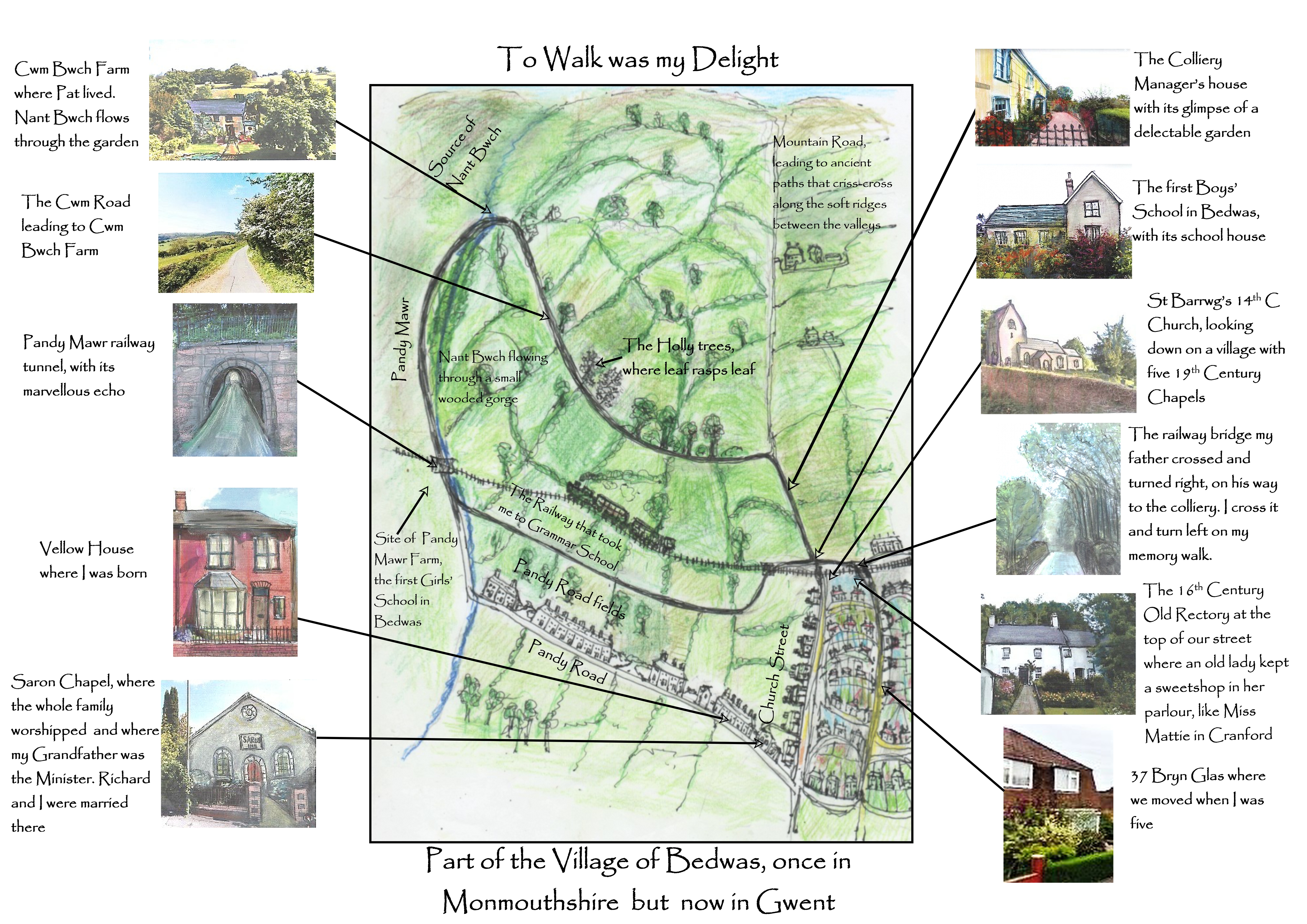
Walking round the Cwm it was always called, although the Cwm Road really follows the contour of the mountain until it comes to the Cwm Farm, a mountain farm in the cwm, or valley, formed by the Cwm brook, then down the road and home across the fields. Although I walked round the Cwm as a child, and later with Richard and the children, I have set my memory walk in the 1960s when I was in my teens and early twenties and walked it countless times.
As I started to write about this, I began to realise what a diverse range of historical and contemporary socio-economic domains I walked through and I want to call the elements of this range, contrasting, or conflicting, worlds. The first is the world of home, in the village of Bedwas in South East Wales. It’s situated on the north side of the Caerphilly Basin, on the steep lower slopes of Bedwas Mountain, until the land flattens out towards the River Rhymney. Home was (and to my brother still is) 37 Bryn Glas, part of the new council estate where we: my parents; my baby brother and I; and my maternal grandparents; moved in 1950. It was built on what had been known as Church Fields, a hilly site, falling down from the Church and Rectory. The names of the streets reflect this; Bryn Teg: Fair Hill; Bryn Fedw: Birch Hill; Bryn Tirion: Gentle Hill; Bryn Golau: Light Hill. Our street is called Bryn Glas: Green or Blue Hill and runs through the centre of the estate, from the top to the bottom. These place names themselves represent conflicting worlds. Welsh was not much spoken in South East Wales, especially in areas where industry had attracted English workers and workers from Europe; and not many streets in Bedwas have Welsh names. There is: Church Street; St Mary Street; Glebe Street, for example; and there is an estate of Council Houses built between the wars that have street names like Hillside, or The Crescent. Our estate was built on a hill so Bryn would have been appropriate for every street; the names anchor the estate firmly in Wales and reclaim a former world but hardly anyone, apart from my grandfather and my mother, knew what they meant, and I had to look them up.
I’ve represented the estate as bigger than it is, partly to show the impact this change had on me and partly to represent the way that, seventy years later, the estate is still not very beautiful, though there are pockets of prettiness. Pandy Road fields, towards the end of my memory walk, are now built over with houses and I can’t bear to walk there. When it was being developed, I wrote a (very bad) poem beginning:
They’re throwing my childhood into that mixer.
They’re churning it up with best quality sand
and all the beauty through which I wandered
is featureless no-man’s land.
And I suppose many people thought the same about Church Fields when our estate was built.
From our house you could see the large Pit Head site of Bedwas Navigation Colliery, with its winding gear and huge slag heap on the side of the green mountain. The trucks (called drams) of waste travelled slowly along a cable track railway to a waiting crane that up-ended them and spilled the contents. At the Pit Head there was a large coking plant, when the ovens were opened there was a wall of fiery coke that slowly fell into bins and cooled; there was a large coal hopper from which the railway trucks were filled; the bathhouse; the lamp room from where the men collected their hard hats, each with a lamp on the front; and the colliery shop from where my father brought home ice-cream as treat on pay day. There was constant background noise from rumbling rolling stock, and the Tannoy. For my father this was the world of work which set the timetable for our days.
But home was also filled with the contrasting world of music and books. My father was a trained singer and he hurried home if there was a concert he wanted to listen to on the radio; we went to local concerts and to Cardiff to the opera. The sitting room was used by my grandfather as a study where he read, and wrote his sermons. My mother used to write poetry, like her grandfather had, when she was young, before domesticity took over her time, though she was always ready to discuss her favourite books. My mind was fed with stories, art books, my mother’s fascinating childhood encyclopaedia; and my grandmother taught me to count in Welsh.
At the top of Bryn Glas, my memory walk starts to become part of a number of contrasting worlds. First, there was the listed Hen Persondy (The old Parson’s House), the first of three successive Rectories in Bedwas. This 16th Century house found itself at the top of a 20th Century Council Estate and next to a bridge over the mid-19th Century Brecon and Merthyr Railway, busy with steam hauled goods trains, many of them drawing long trains of coal-filled trucks, and with passenger trains that had started from Newport. This highly engineered world, with its cuttings and embankments and the crossing places of tunnels and bridges, sliced through fields and settlements. It was one of the railways which closed in 1962, when Beeching’s axe fell, but before it did, I travelled part of the way to my Grammar School in the Rhymney Valley by steam train, from Bedwas railway station, on the opposite side of the road from the church, along the side of the Southern end of the Rhymney valley, through silver Birch woods with tumbling streams, the valley floor and its close packed miners’ cottages and another colliery, far below.
Turning left over the railway bridge at the top of Bryn Glas, means that the colliery is left behind. A few hundred yards brings me to another cluster of contrasting and conflicting worlds. Across the railway, the north side of St Barrwg’s Church was visible through the trees. The church, dating from the 14th Century, perhaps built on the site of an earlier church, was founded as a chantry for one of the Lords of Caerphilly Castle - he wasn’t Welsh, of course. Before the development of the coal mining industry, Bedwas was a farming community, although farming must itself have changed considerably through the centuries. The coming of coal mining caused two conflicting worlds to collide. The established farmers went to Church; the non-conformist miners built Chapels to worship in: one of the biggest is almost opposite the Church.
Then, facing the church, on my side of the railway, is the old Boys’ School. It was one of the schools built in 1868 with money from a charity set up by the owners of the estate of which the Cwm Farm is part. When I was a child, I was always intrigued by stories of the reunions, sometimes very lively, of the surviving old boys. They gathered annually for a dinner with entertainment, part of which was reading from the old log book. Friends of ours now live in the Old School and have refurbished the schoolroom so that it is part of their house. The same charity also started the old girls’ school in Pandy Mawr Farm, in 1809 and, in 1903, on Glebe land at the bottom of Church street, the schools that eventually were taken over by the local education authority. It was here that I started school, and also started on the long journey of explaining how to pronounce my name.
From the old Boy’s School, the walk becomes very steep. It goes past houses old and new, the last one, high above Bedwas, being the Colliery Manager’s house. It represented a world of power, affluence and a more spacious way of living, with its large house and the frustrating glimpse of the garden. Not long afterwards is the turn from Mountain Road to Cwm Road. There are many trees alongside the road but still places where you can look over the Caerphilly Basin at the contrasting worlds of town and castle, with Caerphilly Mountain beyond.
The Cwm Road, level at first, begins to drop as it rounds the hill, and then you can see the deep cwm, at the bottom of which is the Cwm Farm. A school friend, Pat, lived there with her parents and older brother. One day another friend and I went to see her; she took us to her favourite places on the hill behind the farm where we roamed all the afternoon. Pat’s mother was so thrilled that we had come to spend time with her daughter that she made a great fuss of us and gave us apple tart and cream.
We always talked about the brook and the Cwm Farm, but in earlier times, before industry made English the everyday language, we would have talked of Nant Bwch: Goat, or Buck Brook; and the farm should be Fferm y Cwm Bwch. After leaving the farm, the road twists until it turns into the wide lane called Pandy Mawr, or Great Pandy. A Pandy is a Fulling Mill so there must have been one somewhere on Cwm Bwch, perhaps where it flows faster through a small, gorge. It is now wooded and no apparent trace is left of that earlier world of work.
Before reaching Pandy Mawr railway tunnel, Nant Bwch used to flow past a grassy bank, a rural contrast with the highly engineered tunnel. The bed of the brook was surprisingly sandy there, with small fish darting about and it was lovely to sit there and paddle one’s feet. It’s been tarmacked over for parking now and all that destroyed. But Pandy Mawr railway tunnel, now a Grade II listed building, still has a wonderful echo - everyone shouts as they walk through.
Shortly after this, my walk turns into Pandy Road fields, behind Pandy Road, where I was born. When we were still living there, we used to have picnics by the brook and I remember a lot of paddling. The walk leaves the brook, following a path past an ivy clad ruined tower, looking very romantic. In reality, it was the tower containing the winding gear for Bryn Gwyn (White Hill) drift mine. It was one of the ten mines, large or small in the Caerphilly Basin, until Bedwas Navigation Colliery was sunk and became the main place where coal was won. Near the tower was a hilly mound, covered in grasses and wild flowers, which had been the slag heap; it was great place for playing ‘I’m the King of the Castle’. When the drift mine stopped working, the land around returned to farming, as though one world overcame another. But the worlds of farm and mine still collided: the peaceful fields of grazing cattle were crossed by clear field paths, made firm by the feet of miners, including my father and grandfather, walking to and from the colliery. In my memory walk, I follow their footsteps, climb the steepest field and cross under the railway, on my way home.
I loved the road around the Cwm but I would struggle, now, to walk where it was my delight to go. For years after I left home, if I felt the tug of South Wales, it was the Cwm Road I visualised. We travel to South Wales a number of times a year and one of these is always at Easter time. One year, when the children were small, I was ill and we couldn’t go. The weather was very cold and I was distraught. The memory of the holly trees on the Cwm Road seemed to mirror my bitter mood and I wrote a bad poem with very poor scansion, called This Cold Spring. This is the first stanza:
This cold Spring
the wind, harsh in the holly tree
as leaf rasps leaf, is calling me
and ‘Home, Come Home!’
it cries constantly.
I no longer feel the tug of South Wales as strongly now: the wind has stopped calling me, but still I love to think of walking round the Cwm: And with Memory I was there…
Walking round the Cwm it was always called, although the Cwm Road really follows the contour of the mountain until it comes to the Cwm Farm, a mountain farm in the cwm, or valley, formed by the Cwm brook, then down the road and home across the fields. Although I walked round the Cwm as a child, and later with Richard and the children, I have set my memory walk in the 1960s when I was in my teens and early twenties and walked it countless times.
As I started to write about this, I began to realise what a diverse range of historical and contemporary socio-economic domains I walked through and I want to call the elements of this range, contrasting, or conflicting, worlds. The first is the world of home, in the village of Bedwas in South East Wales. It’s situated on the north side of the Caerphilly Basin, on the steep lower slopes of Bedwas Mountain, until the land flattens out towards the River Rhymney. Home was (and to my brother still is) 37 Bryn Glas, part of the new council estate where we: my parents; my baby brother and I; and my maternal grandparents; moved in 1950. It was built on what had been known as Church Fields, a hilly site, falling down from the Church and Rectory. The names of the streets reflect this; Bryn Teg: Fair Hill; Bryn Fedw: Birch Hill; Bryn Tirion: Gentle Hill; Bryn Golau: Light Hill. Our street is called Bryn Glas: Green or Blue Hill and runs through the centre of the estate, from the top to the bottom. These place names themselves represent conflicting worlds. Welsh was not much spoken in South East Wales, especially in areas where industry had attracted English workers and workers from Europe; and not many streets in Bedwas have Welsh names. There is: Church Street; St Mary Street; Glebe Street, for example; and there is an estate of Council Houses built between the wars that have street names like Hillside, or The Crescent. Our estate was built on a hill so Bryn would have been appropriate for every street; the names anchor the estate firmly in Wales and reclaim a former world but hardly anyone, apart from my grandfather and my mother, knew what they meant, and I had to look them up.
I’ve represented the estate as bigger than it is, partly to show the impact this change had on me and partly to represent the way that, seventy years later, the estate is still not very beautiful, though there are pockets of prettiness. Pandy Road fields, towards the end of my memory walk, are now built over with houses and I can’t bear to walk there. When it was being developed, I wrote a (very bad) poem beginning:
They’re throwing my childhood into that mixer.
They’re churning it up with best quality sand
and all the beauty through which I wandered
is featureless no-man’s land.
And I suppose many people thought the same about Church Fields when our estate was built.
From our house you could see the large Pit Head site of Bedwas Navigation Colliery, with its winding gear and huge slag heap on the side of the green mountain. The trucks (called drams) of waste travelled slowly along a cable track railway to a waiting crane that up-ended them and spilled the contents. At the Pit Head there was a large coking plant, when the ovens were opened there was a wall of fiery coke that slowly fell into bins and cooled; there was a large coal hopper from which the railway trucks were filled; the bathhouse; the lamp room from where the men collected their hard hats, each with a lamp on the front; and the colliery shop from where my father brought home ice-cream as treat on pay day. There was constant background noise from rumbling rolling stock, and the Tannoy. For my father this was the world of work which set the timetable for our days.
But home was also filled with the contrasting world of music and books. My father was a trained singer and he hurried home if there was a concert he wanted to listen to on the radio; we went to local concerts and to Cardiff to the opera. The sitting room was used by my grandfather as a study where he read, and wrote his sermons. My mother used to write poetry, like her grandfather had, when she was young, before domesticity took over her time, though she was always ready to discuss her favourite books. My mind was fed with stories, art books, my mother’s fascinating childhood encyclopaedia; and my grandmother taught me to count in Welsh.
At the top of Bryn Glas, my memory walk starts to become part of a number of contrasting worlds. First, there was the listed Hen Persondy (The old Parson’s House), the first of three successive Rectories in Bedwas. This 16th Century house found itself at the top of a 20th Century Council Estate and next to a bridge over the mid-19th Century Brecon and Merthyr Railway, busy with steam hauled goods trains, many of them drawing long trains of coal-filled trucks, and with passenger trains that had started from Newport. This highly engineered world, with its cuttings and embankments and the crossing places of tunnels and bridges, sliced through fields and settlements. It was one of the railways which closed in 1962, when Beeching’s axe fell, but before it did, I travelled part of the way to my Grammar School in the Rhymney Valley by steam train, from Bedwas railway station, on the opposite side of the road from the church, along the side of the Southern end of the Rhymney valley, through silver Birch woods with tumbling streams, the valley floor and its close packed miners’ cottages and another colliery, far below.
Turning left over the railway bridge at the top of Bryn Glas, means that the colliery is left behind. A few hundred yards brings me to another cluster of contrasting and conflicting worlds. Across the railway, the north side of St Barrwg’s Church was visible through the trees. The church, dating from the 14th Century, perhaps built on the site of an earlier church, was founded as a chantry for one of the Lords of Caerphilly Castle - he wasn’t Welsh, of course. Before the development of the coal mining industry, Bedwas was a farming community, although farming must itself have changed considerably through the centuries. The coming of coal mining caused two conflicting worlds to collide. The established farmers went to Church; the non-conformist miners built Chapels to worship in: one of the biggest is almost opposite the Church.
Then, facing the church, on my side of the railway, is the old Boys’ School. It was one of the schools built in 1868 with money from a charity set up by the owners of the estate of which the Cwm Farm is part. When I was a child, I was always intrigued by stories of the reunions, sometimes very lively, of the surviving old boys. They gathered annually for a dinner with entertainment, part of which was reading from the old log book. Friends of ours now live in the Old School and have refurbished the schoolroom so that it is part of their house. The same charity also started the old girls’ school in Pandy Mawr Farm, in 1809 and, in 1903, on Glebe land at the bottom of Church street, the schools that eventually were taken over by the local education authority. It was here that I started school, and also started on the long journey of explaining how to pronounce my name.
From the old Boy’s School, the walk becomes very steep. It goes past houses old and new, the last one, high above Bedwas, being the Colliery Manager’s house. It represented a world of power, affluence and a more spacious way of living, with its large house and the frustrating glimpse of the garden. Not long afterwards is the turn from Mountain Road to Cwm Road. There are many trees alongside the road but still places where you can look over the Caerphilly Basin at the contrasting worlds of town and castle, with Caerphilly Mountain beyond.
The Cwm Road, level at first, begins to drop as it rounds the hill, and then you can see the deep cwm, at the bottom of which is the Cwm Farm. A school friend, Pat, lived there with her parents and older brother. One day another friend and I went to see her; she took us to her favourite places on the hill behind the farm where we roamed all the afternoon. Pat’s mother was so thrilled that we had come to spend time with her daughter that she made a great fuss of us and gave us apple tart and cream.
We always talked about the brook and the Cwm Farm, but in earlier times, before industry made English the everyday language, we would have talked of Nant Bwch: Goat, or Buck Brook; and the farm should be Fferm y Cwm Bwch. After leaving the farm, the road twists until it turns into the wide lane called Pandy Mawr, or Great Pandy. A Pandy is a Fulling Mill so there must have been one somewhere on Cwm Bwch, perhaps where it flows faster through a small, gorge. It is now wooded and no apparent trace is left of that earlier world of work.
Before reaching Pandy Mawr railway tunnel, Nant Bwch used to flow past a grassy bank, a rural contrast with the highly engineered tunnel. The bed of the brook was surprisingly sandy there, with small fish darting about and it was lovely to sit there and paddle one’s feet. It’s been tarmacked over for parking now and all that destroyed. But Pandy Mawr railway tunnel, now a Grade II listed building, still has a wonderful echo - everyone shouts as they walk through.
Shortly after this, my walk turns into Pandy Road fields, behind Pandy Road, where I was born. When we were still living there, we used to have picnics by the brook and I remember a lot of paddling. The walk leaves the brook, following a path past an ivy clad ruined tower, looking very romantic. In reality, it was the tower containing the winding gear for Bryn Gwyn (White Hill) drift mine. It was one of the ten mines, large or small in the Caerphilly Basin, until Bedwas Navigation Colliery was sunk and became the main place where coal was won. Near the tower was a hilly mound, covered in grasses and wild flowers, which had been the slag heap; it was great place for playing ‘I’m the King of the Castle’. When the drift mine stopped working, the land around returned to farming, as though one world overcame another. But the worlds of farm and mine still collided: the peaceful fields of grazing cattle were crossed by clear field paths, made firm by the feet of miners, including my father and grandfather, walking to and from the colliery. In my memory walk, I follow their footsteps, climb the steepest field and cross under the railway, on my way home.
I loved the road around the Cwm but I would struggle, now, to walk where it was my delight to go. For years after I left home, if I felt the tug of South Wales, it was the Cwm Road I visualised. We travel to South Wales a number of times a year and one of these is always at Easter time. One year, when the children were small, I was ill and we couldn’t go. The weather was very cold and I was distraught. The memory of the holly trees on the Cwm Road seemed to mirror my bitter mood and I wrote a bad poem with very poor scansion, called This Cold Spring. This is the first stanza:
This cold Spring
the wind, harsh in the holly tree
as leaf rasps leaf, is calling me
and ‘Home, Come Home!’
it cries constantly.
I no longer feel the tug of South Wales as strongly now: the wind has stopped calling me, but still I love to think of walking round the Cwm: And with Memory I was there…
Awena Carter, 30 September 2020
Awena Carter, 30 September 2020
Madlen Kobi
Madlen Kobi
Walk 1: Encounters with Warming Objects
Remembering a Winter Walk through Huangjueping Neighbourhood (Chongqing, China)
Memory-map, words and photographs contributed during Walks to Remember During a Pandemic, May 2020.
Madlen Kobi's memory-map retraces a winter walk through Huangjueping neighbourhood in Chongqing, China. Combining ethnographic observation with personal experience, the remembered walk explores how architecture, everyday objects and social encounters shape experiences of warmth, place and belonging.
Madlen Kobi
Walk 1: Encounters with Warming Objects
Remembering a Winter Walk through Huangjueping Neighbourhood (Chongqing, China)
Memory-map, words and photographs contributed during Walks to Remember During a Pandemic, May 2020.
Madlen Kobi's memory-map retraces a winter walk through Huangjueping neighbourhood in Chongqing, China. Combining ethnographic observation with personal experience, the remembered walk explores how architecture, everyday objects and social encounters shape experiences of warmth, place and belonging.
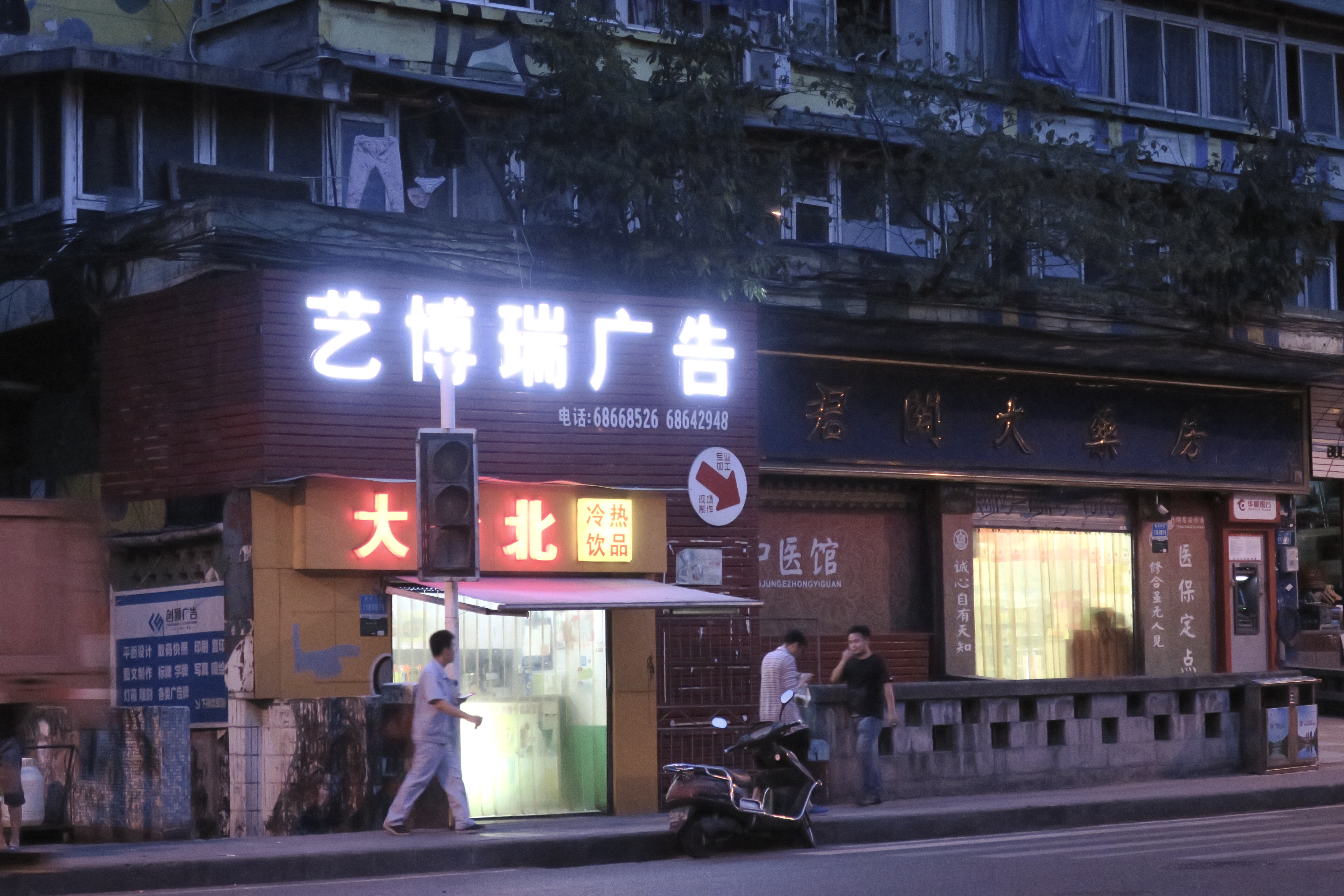
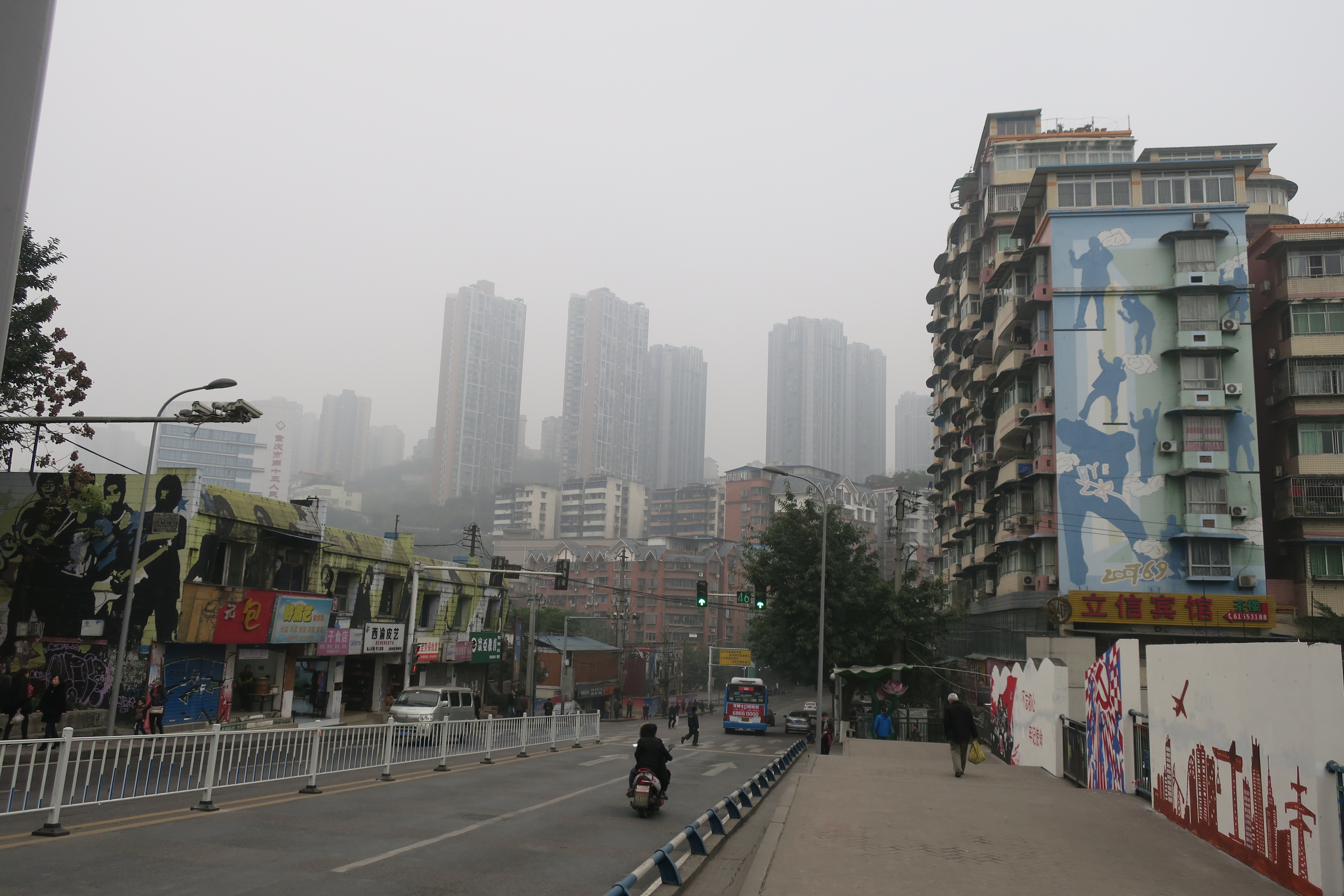
Accompanied by a green tea that was given to me by a Chinese friend during my last visit to Chongqing in December 2017, I am sitting here at my desk in Bern (Switzerland) and longing to walk again through Huangjueping neighbourhood. As much as I love exploring mountainous areas, I am also very much attracted to dense urban spaces. During my ethnographic research, I developed a tradition of going on both short and longer walks through urban neighbourhoods, letting my curiosity guide me, often without a clear destination in mind. I enjoy getting inspired by particular architecture, the way balconies are used, street life, public places or unexpected views around the corner of the next house. And whenever such an opportunity arises, I stop for a little chat with an ice cream vendor, a school kid playing or the noodle shop waitress. These talks enrich my impressions of a place and create specific bonds with it.
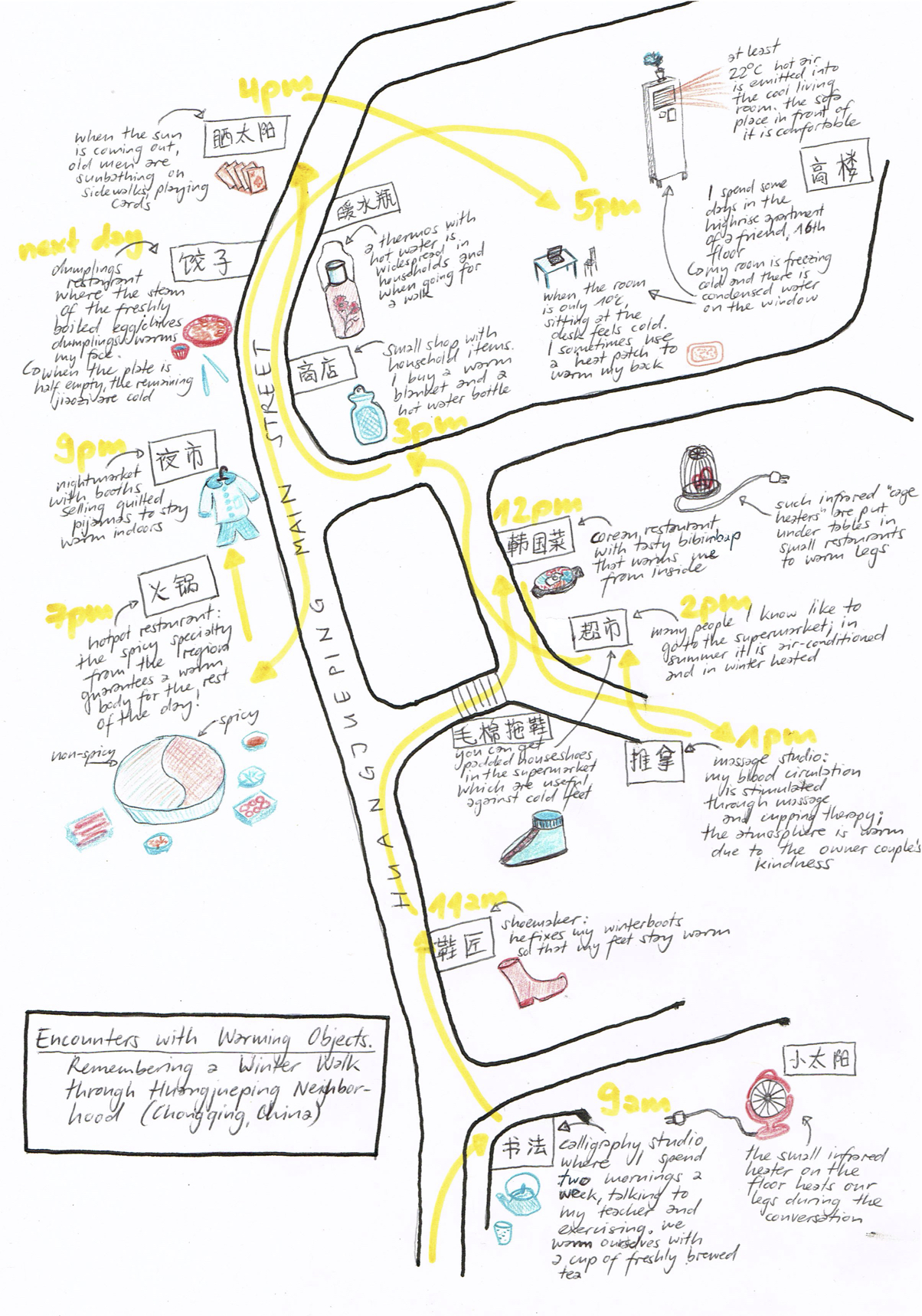
Chongqing is a city of roughly 8 million inhabitants; it is impossible to walk the entire city territory. As I lived in Huangjueping neighbourhood for several months, I miss strolling the main street and seeing the places transforming throughout the different seasons and the various times of the day. Especially in winter, walking is a good way to keep warm as indoor spaces are often unheated due to the lack of central and district heating, leading to cold apartments with an ambient temperature of around 10°C. People deal with the cold through the use of clothes, food, objects and electric devices – as my map shows. In this walk, I take you through different public and private places on Huangjueping Main Road and describe the thermal sensations that the objects encountered invoke in me with regard to the winter cold.
I hope to be able once again to walk in Huangjueping in spring 2021 when, with luck, COVID-19 travel restrictions should be over. Then I can continue my fieldwork, enriching my mental map with new lived experiences.
Accompanied by a green tea that was given to me by a Chinese friend during my last visit to Chongqing in December 2017, I am sitting here at my desk in Bern (Switzerland) and longing to walk again through Huangjueping neighbourhood. As much as I love exploring mountainous areas, I am also very much attracted to dense urban spaces. During my ethnographic research, I developed a tradition of going on both short and longer walks through urban neighbourhoods, letting my curiosity guide me, often without a clear destination in mind. I enjoy getting inspired by particular architecture, the way balconies are used, street life, public places or unexpected views around the corner of the next house. And whenever such an opportunity arises, I stop for a little chat with an ice cream vendor, a school kid playing or the noodle shop waitress. These talks enrich my impressions of a place and create specific bonds with it.
Chongqing is a city of roughly 8 million inhabitants; it is impossible to walk the entire city territory. As I lived in Huangjueping neighbourhood for several months, I miss strolling the main street and seeing the places transforming throughout the different seasons and the various times of the day. Especially in winter, walking is a good way to keep warm as indoor spaces are often unheated due to the lack of central and district heating, leading to cold apartments with an ambient temperature of around 10°C. People deal with the cold through the use of clothes, food, objects and electric devices – as my map shows. In this walk, I take you through different public and private places on Huangjueping Main Road and describe the thermal sensations that the objects encountered invoke in me with regard to the winter cold.
I hope to be able once again to walk in Huangjueping in spring 2021 when, with luck, COVID-19 travel restrictions should be over. Then I can continue my fieldwork, enriching my mental map with new lived experiences.
Madlen Kobi, 13 May 2020.
Madlen Kobi, 13 May 2020.
Madlen Kobi's Walk 2: Encounters with Ventilation Heritage.
Architectural Materiality in Huangjueping Neighbourhood (Chongqing, China)
Madlen Kobi's Walk 2: Encounters with Ventilation Heritage.
Architectural Materiality in Huangjueping Neighbourhood (Chongqing, China)
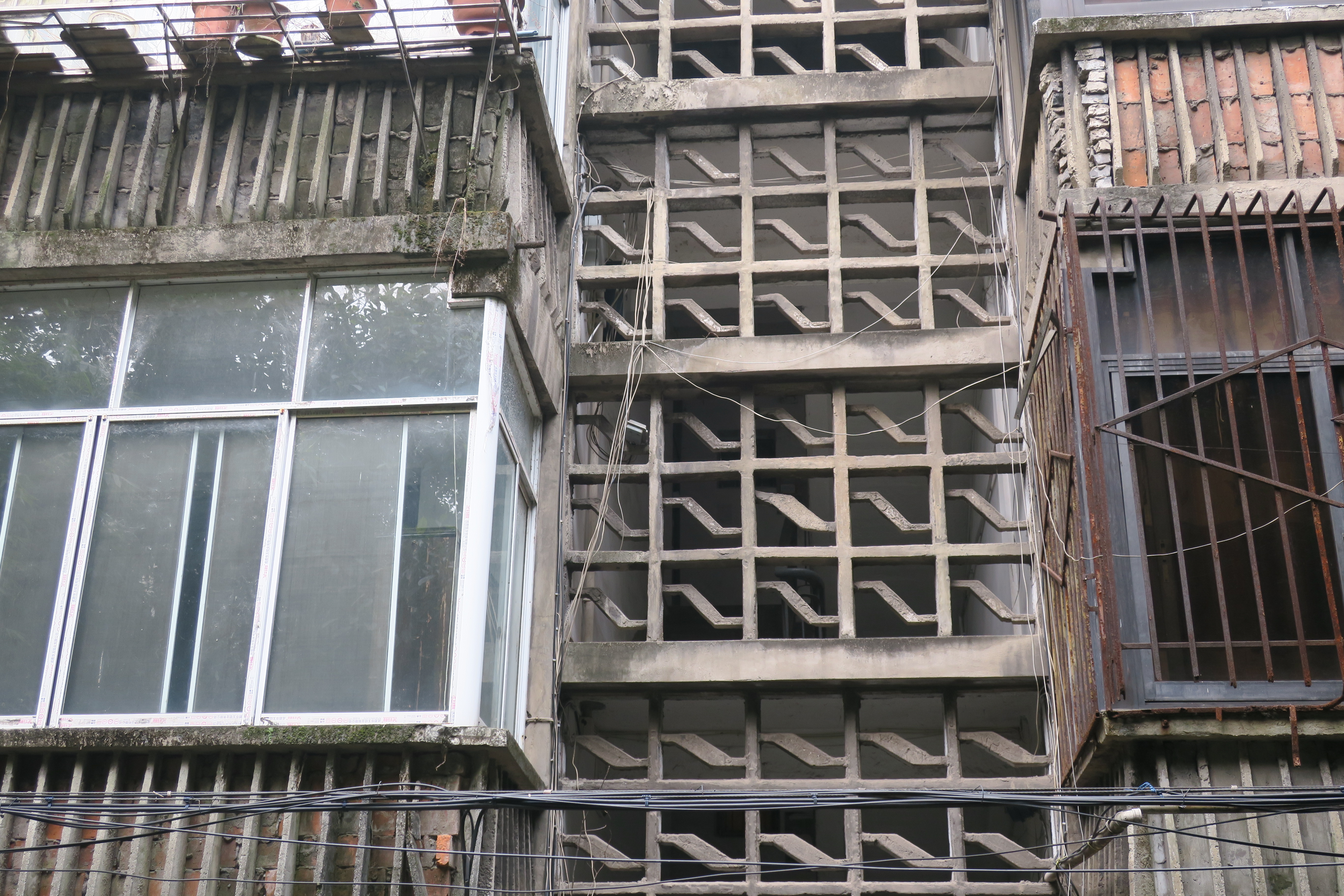
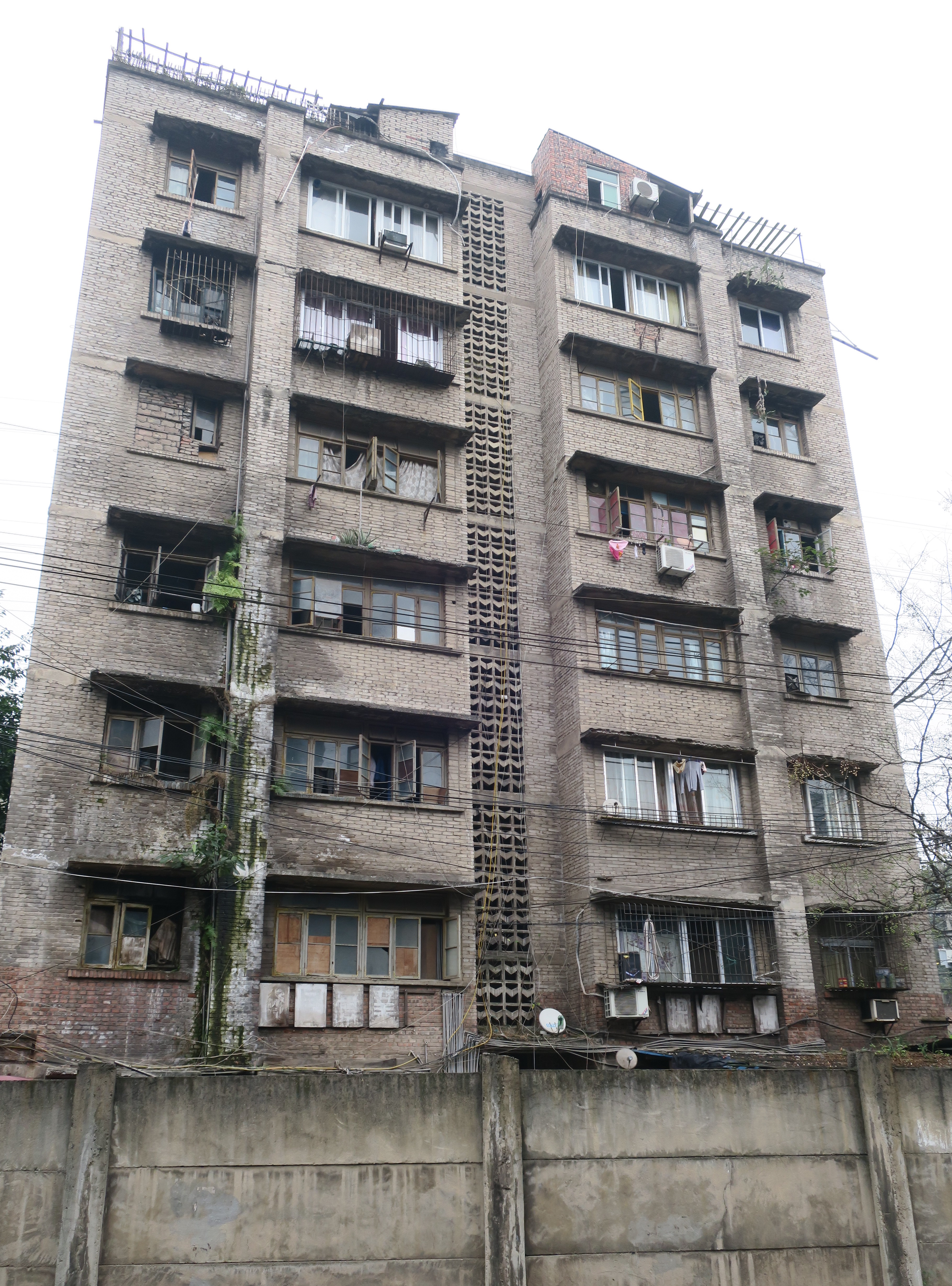
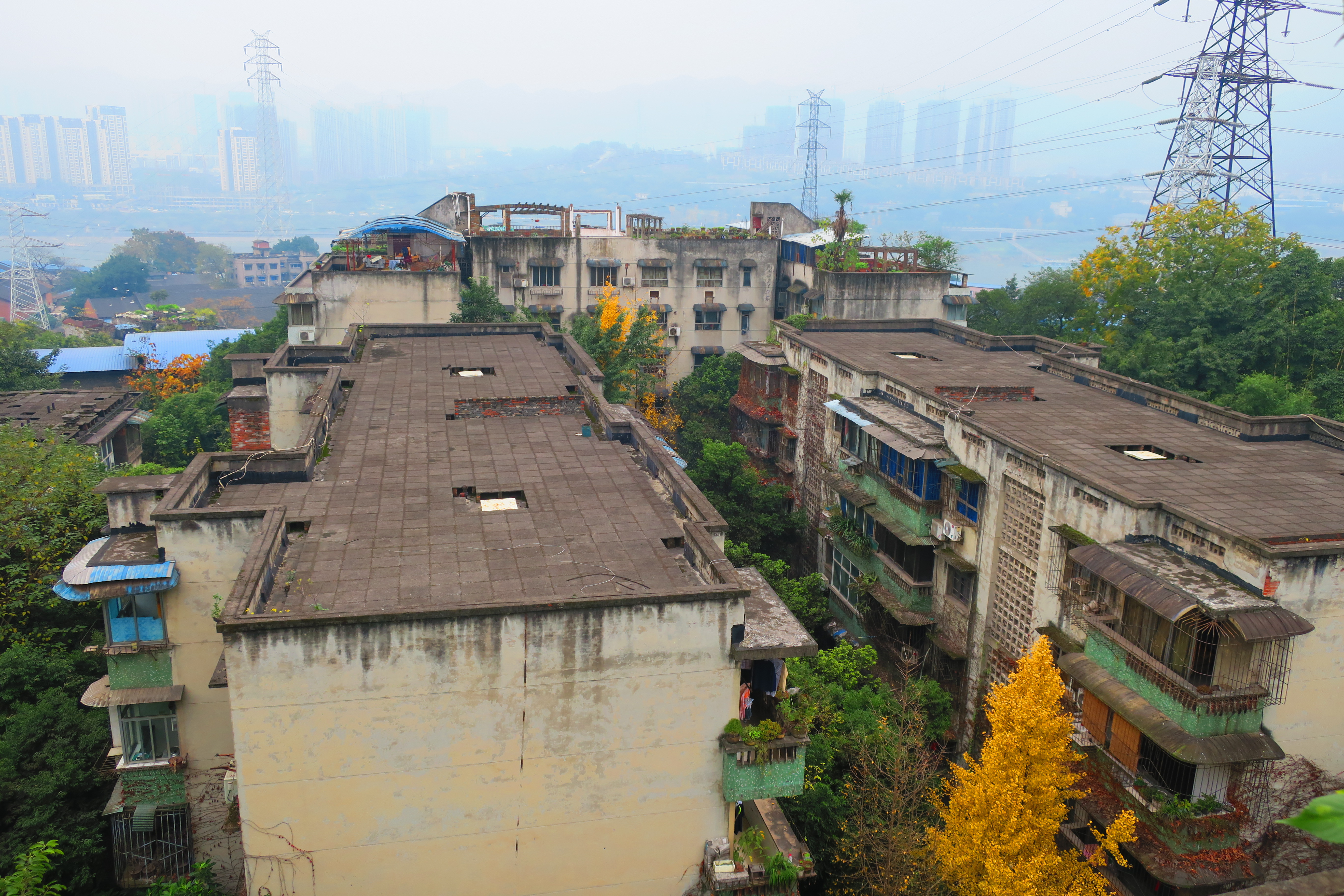
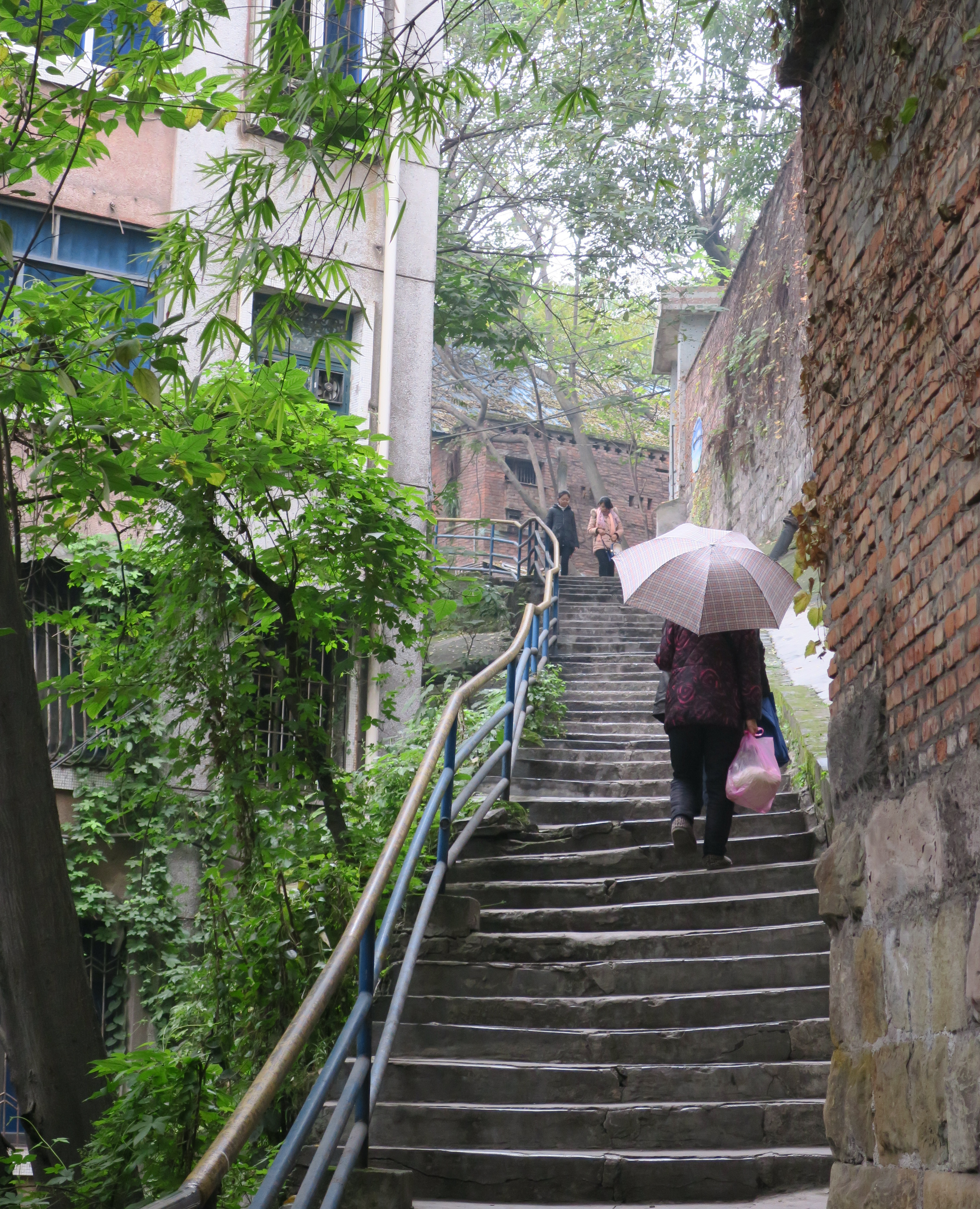
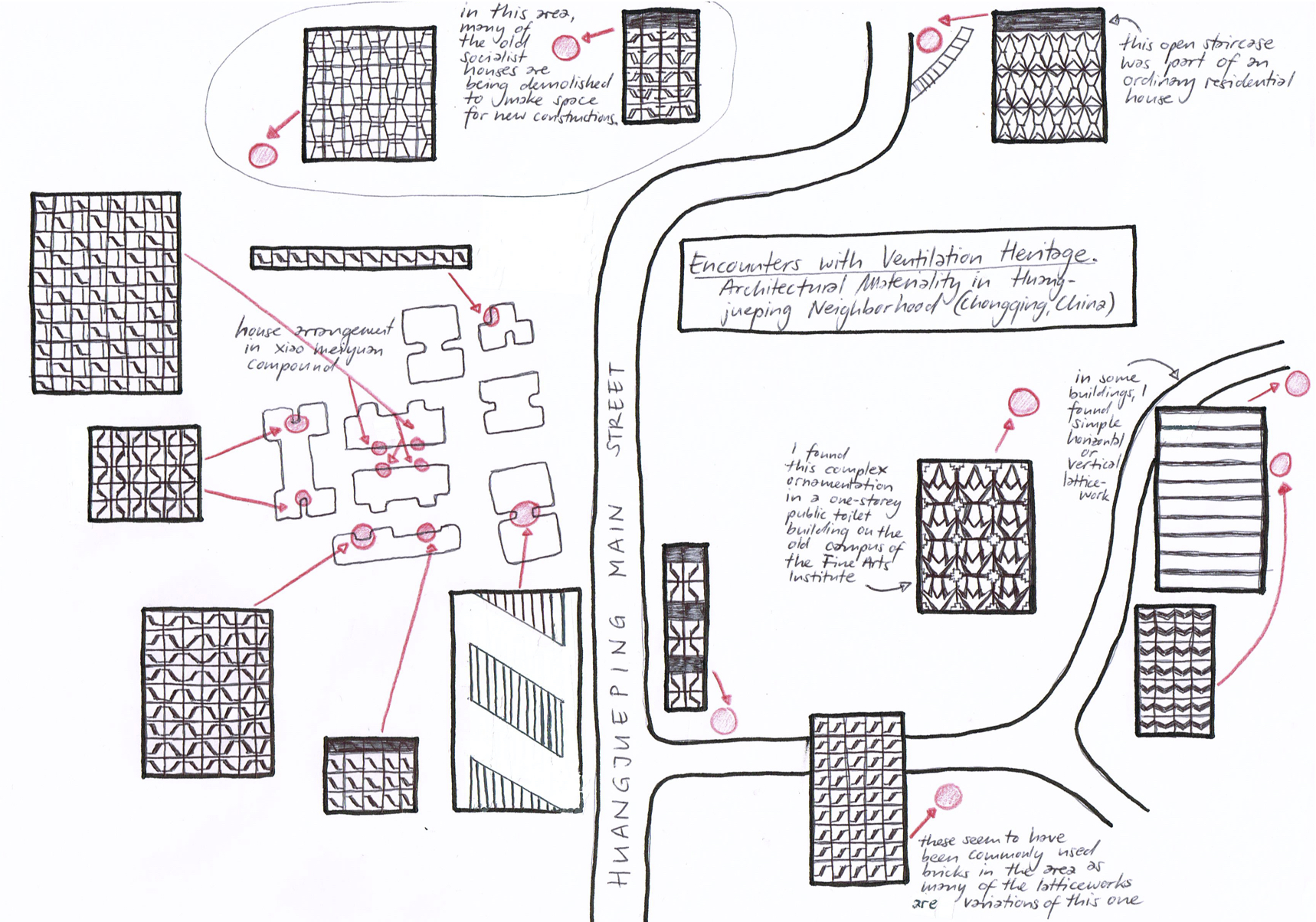
While winter walks in Chongqing can be a way to get warm from the inside during the search for heating objects, a welcome relief from the hot summer temperatures – up to 40°C in July and August – comes in the form of creating a cool breeze. Due to the location of the city in the Sichuan Basin, wind intensity is rather low. Nevertheless, we find traces of a thermal heritage of ventilation in many buildings constructed prior to the 1990s, when the aircon started to become a popular device to lower indoor temperatures.
This walk takes you to some fine examples of the ornamental application of permeable walls in socialist buildings in Huangjueping district. The creativity with which bricks were arranged in open staircases highlights the importance of air exchange between indoors and outdoors, which is essential in the Chongqing climate with its average annual humidity of 80%. In addition, the Xiao Meiyuan Compound in the centre of the map reveals some of the characteristic housing shapes from a bird’s-eye perspective, visualizing the integral role of air and light shafts for cross-ventilating apartments. It is part of my ongoing research to learn more about such socialist subtropical architecture prevalent in the region.
While winter walks in Chongqing can be a way to get warm from the inside during the search for heating objects, a welcome relief from the hot summer temperatures – up to 40°C in July and August – comes in the form of creating a cool breeze. Due to the location of the city in the Sichuan Basin, wind intensity is rather low. Nevertheless, we find traces of a thermal heritage of ventilation in many buildings constructed prior to the 1990s, when the aircon started to become a popular device to lower indoor temperatures.
This walk takes you to some fine examples of the ornamental application of permeable walls in socialist buildings in Huangjueping district. The creativity with which bricks were arranged in open staircases highlights the importance of air exchange between indoors and outdoors, which is essential in the Chongqing climate with its average annual humidity of 80%. In addition, the Xiao Meiyuan Compound in the centre of the map reveals some of the characteristic housing shapes from a bird’s-eye perspective, visualizing the integral role of air and light shafts for cross-ventilating apartments. It is part of my ongoing research to learn more about such socialist subtropical architecture prevalent in the region.
Madlen Kobi, 13 May 2020.
Madlen Kobi, 13 May 2020.
Liz & Len Bagley
Liz and Len Bagley
Beinn Bhreac Walk: North West Arran, May 2009
Memory-map, words and photographs contributed during Walks to Remember During a Pandemic, May 2020.
Liz and Len Bagley's memory-map retraces a mountain walk across the north-west of the Isle of Arran. Richly describing the landscape, weather and wildlife encountered along the route, the remembered walk becomes both a celebration of a shared journey and a reflection on changing physical ability and the value of returning through memory to places that can no longer be walked.
Liz and Len Bagley
Beinn Bhreac Walk: North West Arran, May 2009
Memory-map, words and photographs contributed during Walks to Remember During a Pandemic, May 2020.
Liz and Len Bagley's memory-map retraces a mountain walk across the north-west of the Isle of Arran. Richly describing the landscape, weather and wildlife encountered along the route, the remembered walk becomes both a celebration of a shared journey and a reflection on changing physical ability and the value of returning through memory to places that can no longer be walked.
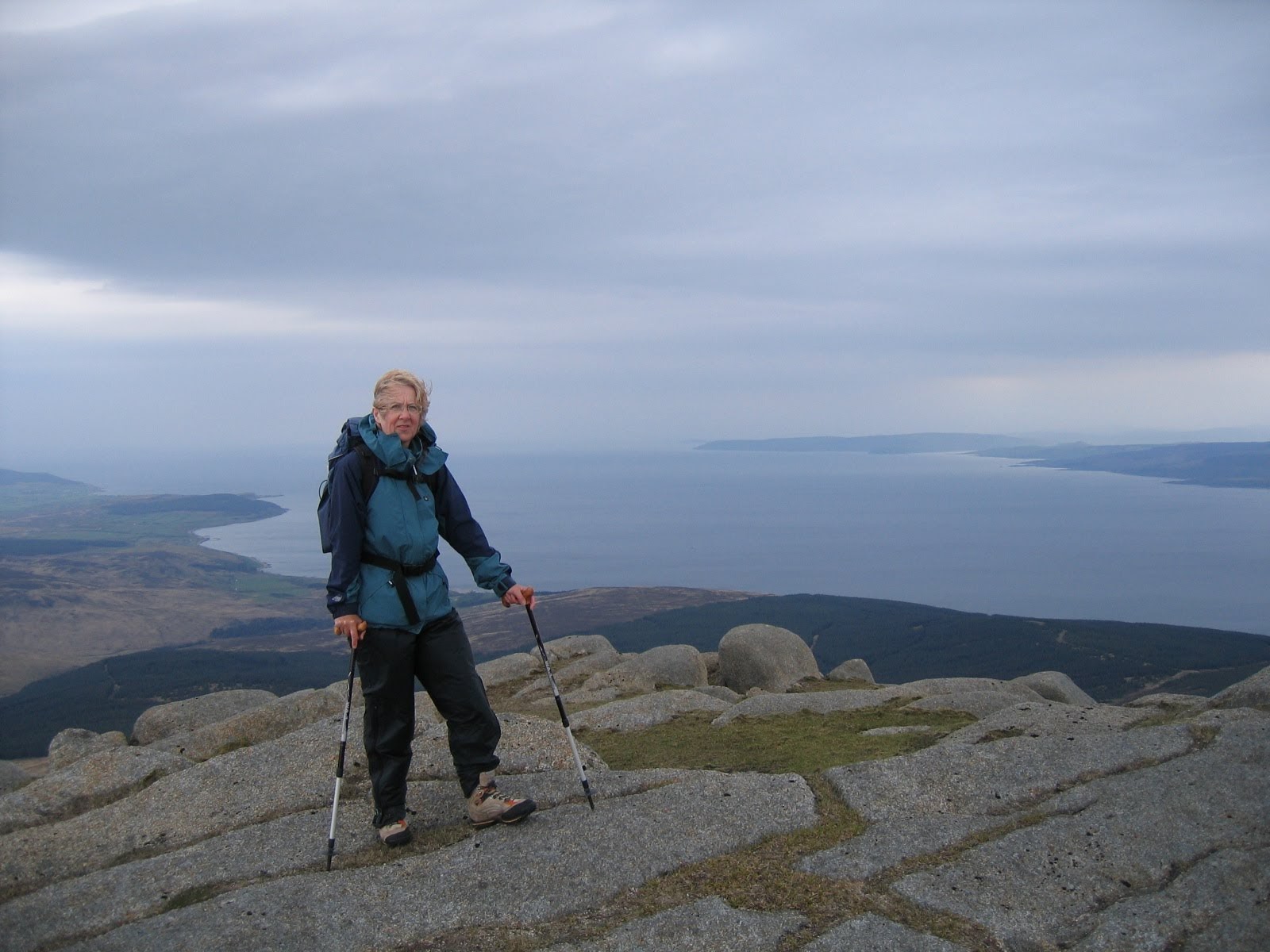
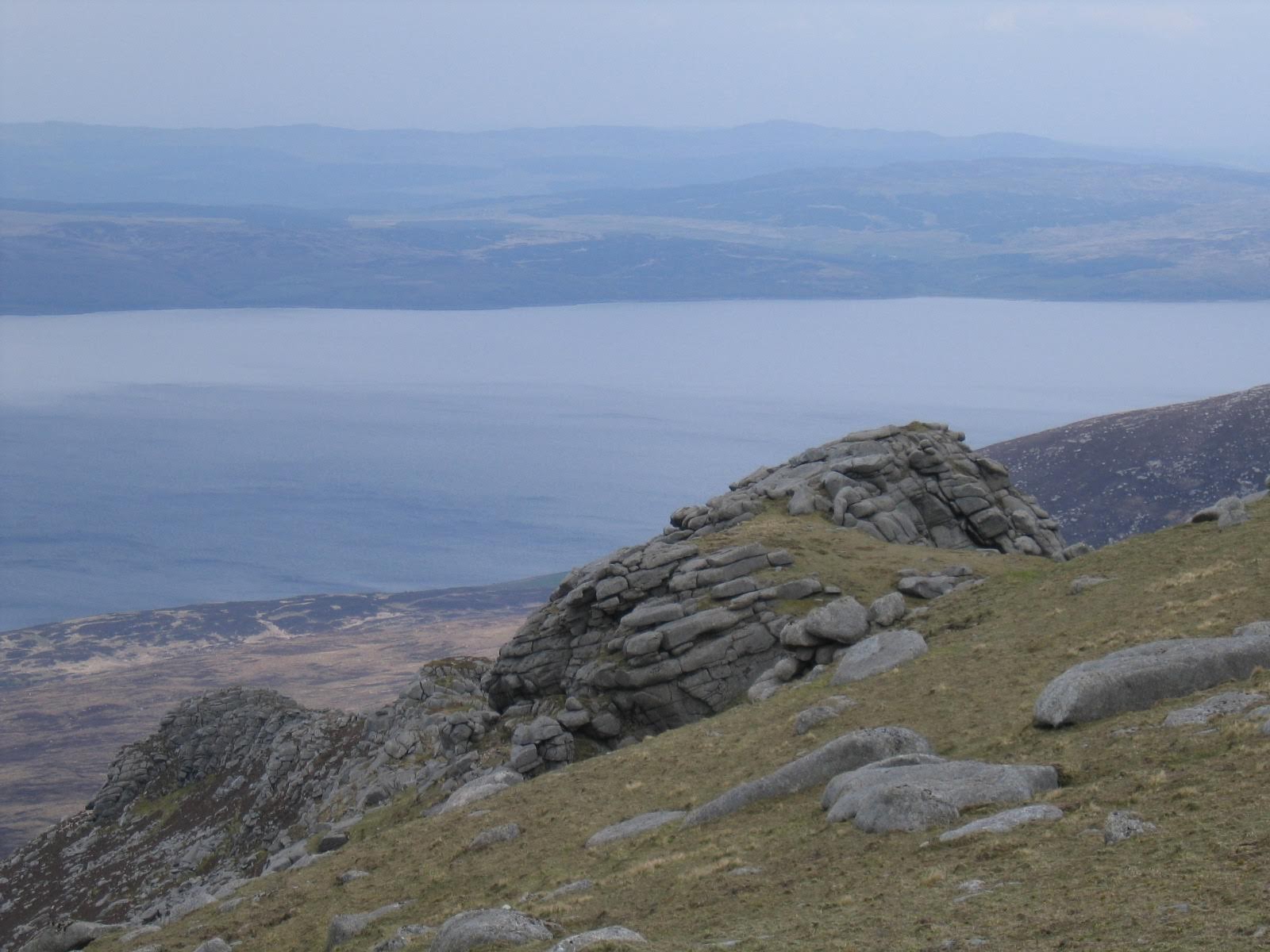
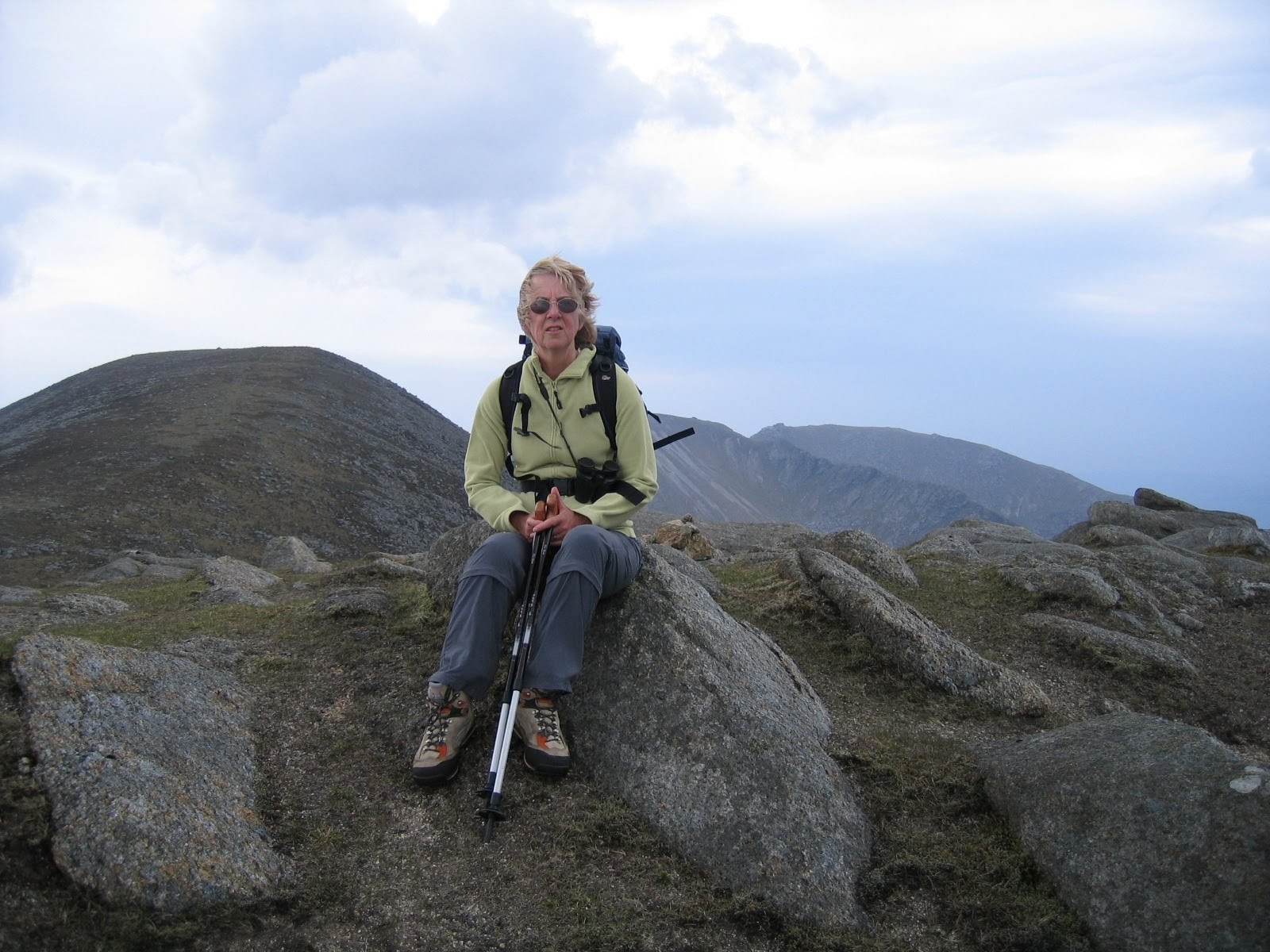
We visited the Isle of Arran several times between 2000 and 2010. Usually we stayed in a tiny self-catering cottage called Poppies, about a mile north of Pirnmill. Poppies was built long ago at the top of a raised beach, sheltered under the wind sculpted oaks which covered the low cliffs. We had heard of this walk and traced the possible route on the map but somehow had never plucked up the courage to attempt it. In May 2009, however, we decided it was now or never.
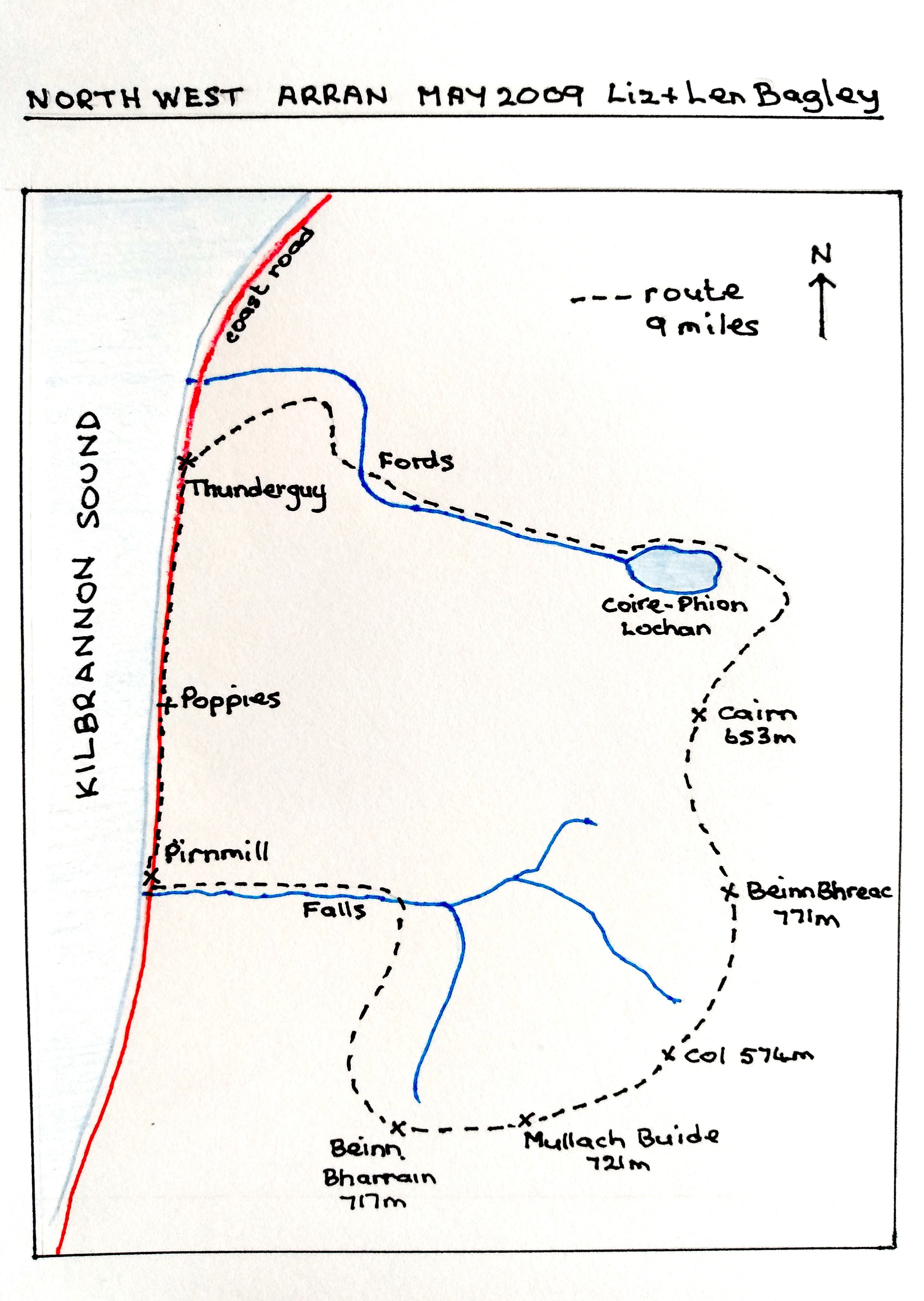
We chose a warm still day and set off with extra warm clothes, plenty of food and water and a certain amount of trepidation. As we walked northwards along the road the oystercatchers, ringed plovers and black guillemots, which nest at the edge of the beach, announced our approach with raucous warning calls. At Thunderguy we left the road and followed a rough track eastwards between a few houses and stunted oak trees. We followed a clearly marked path over open ground with a clear and rather intimidating view of our route ahead. The path climbed gently at first over land that was rough, wet and tussocky and we were grateful for the easy walking on the well used path. Cuckoos were calling all around us from the scattered trees, reminding us of childhood when these calls were an everyday part of summer.
Soon the path became steeper as we crossed the fords and followed the stream with the unpronounceable name of Uisge Soluis Mhoir up to the dark forbidding lake called Coire-Fhionn Lochan (330m). After catching our breath we walked along the northern edge of the lake, to the col overlooking steep sided Glen Catacol and marvelled at the rock strewn landscape around us. Turning south we followed an intermittent path up the rocky shoulder of Beinn Bhreac, passing the cairn (653m) and finally reached the summit (771m). Below us to the east was Loch Tanna, scoured out of the rock by glaciers countless years ago but so barren and desolate it looked as though they had only just retreated.
The wind steadily increased as we climbed and the temperature fell dramatically so we hastily donned extra fleeces and windproof coats. The views were truly awe inspiring. Turning towards the west we could see over the Kilbrannan Sound, over the Kintyre Peninsula to the islands of Jura and Islay in the distance. To the east was the majestic Goat Fell and much of the southern part of the island was spread out before us. After spending so long just gazing in speechless silence we realised how hungry and cold we were so we had a very brief lunch huddled together for shelter.
While we ate we pondered the next part of our walk. The path seemed much more indistinct along the ridge and from our vantage point looked impossible to negotiate in places. Our chosen route became increasingly rocky and I resorted to hanging on to Len's rucksack to avoid being blown over by the gale force wind sweeping in from the Atlantic. We crossed the col of Bealach an Fhadaidh and reached Mullach Buidhe (721m).
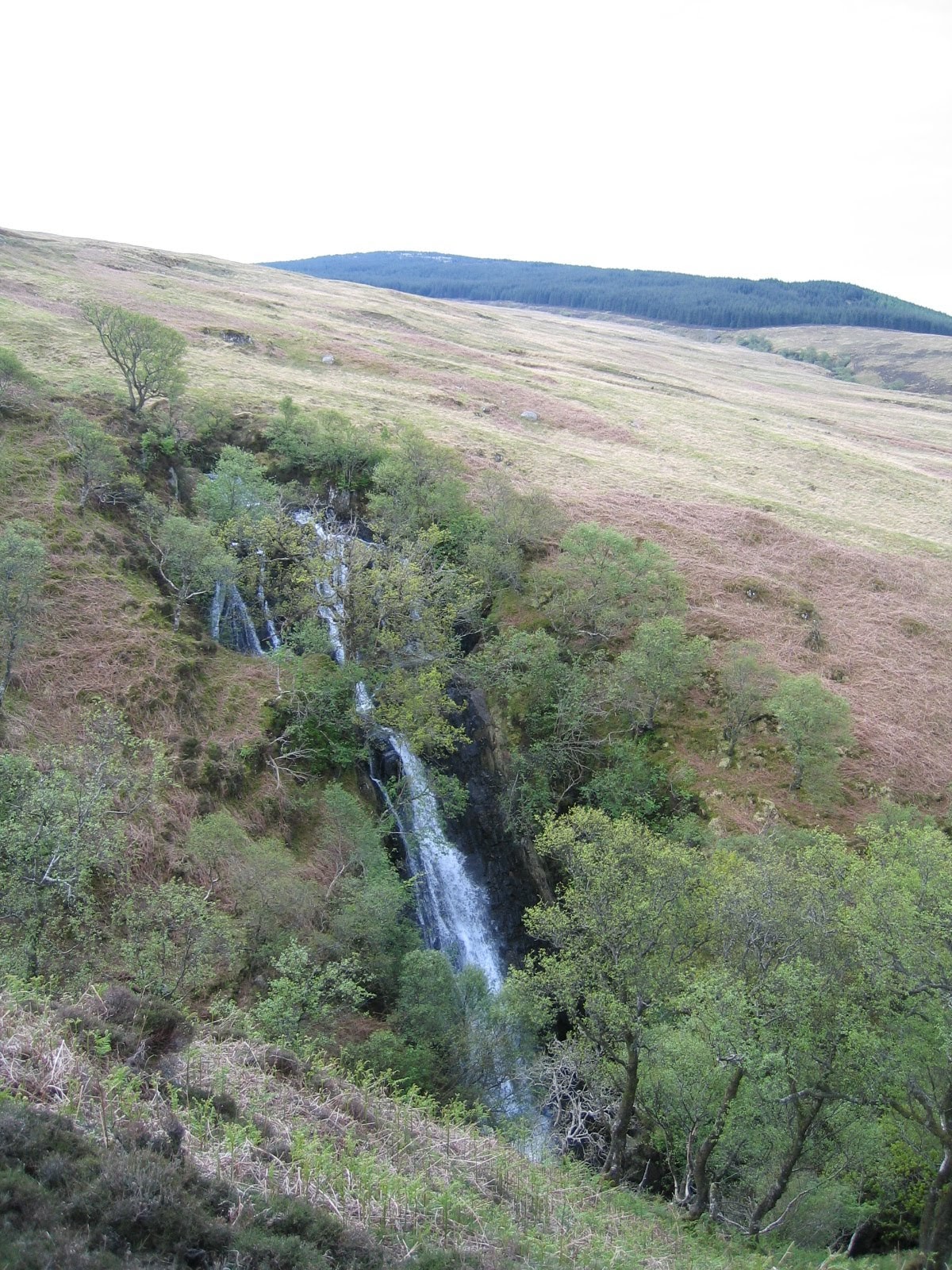
The next part of the walk was the most difficult. Any semblance of a path disappeared and we had to pick our way carefully to avoid cliff faces. We descended the precipitous shoulder of Caisteal na h-lolaire (717m), stopping frequently to admire the glorious view and to choose the safest route down the boulder-strewn slope. Eventually we arrived safely at the strip of relatively flat boggy land we had encountered near Thunderguy further north. We followed the course of the Allt Gobhlach, avoiding an unexpected gully, until we reached the final steep descent. The stream plunged noisily over a cliff into an oak filled valley and we followed an indistinct path along its rim until a clearer path led us into the shelter of oak woodland. We emerged onto the coastal road exhilarated but with quivering legs and sank gratefully onto a seat outside Pirnmill post-office with the most delicious ice-creams in the whole of Scotland.
This is a very special walk for me. It proved to be my last 'hard' walk because a knee injury a few months later made long, steep descents impossible. I am so glad I have done it.
We visited the Isle of Arran several times between 2000 and 2010. Usually we stayed in a tiny self-catering cottage called Poppies, about a mile north of Pirnmill. Poppies was built long ago at the top of a raised beach, sheltered under the wind sculpted oaks which covered the low cliffs. We had heard of this walk and traced the possible route on the map but somehow had never plucked up the courage to attempt it. In May 2009, however, we decided it was now or never.
We chose a warm still day and set off with extra warm clothes, plenty of food and water and a certain amount of trepidation. As we walked northwards along the road the oystercatchers, ringed plovers and black guillemots, which nest at the edge of the beach, announced our approach with raucous warning calls. At Thunderguy we left the road and followed a rough track eastwards between a few houses and stunted oak trees. We followed a clearly marked path over open ground with a clear and rather intimidating view of our route ahead. The path climbed gently at first over land that was rough, wet and tussocky and we were grateful for the easy walking on the well used path. Cuckoos were calling all around us from the scattered trees, reminding us of childhood when these calls were an everyday part of summer.
Soon the path became steeper as we crossed the fords and followed the stream with the unpronounceable name of Uisge Soluis Mhoir up to the dark forbidding lake called Coire-Fhionn Lochan (330m). After catching our breath we walked along the northern edge of the lake, to the col overlooking steep sided Glen Catacol and marvelled at the rock strewn landscape around us. Turning south we followed an intermittent path up the rocky shoulder of Beinn Bhreac, passing the cairn (653m) and finally reached the summit (771m). Below us to the east was Loch Tanna, scoured out of the rock by glaciers countless years ago but so barren and desolate it looked as though they had only just retreated.
The wind steadily increased as we climbed and the temperature fell dramatically so we hastily donned extra fleeces and windproof coats. The views were truly awe inspiring. Turning towards the west we could see over the Kilbrannan Sound, over the Kintyre Peninsula to the islands of Jura and Islay in the distance. To the east was the majestic Goat Fell and much of the southern part of the island was spread out before us. After spending so long just gazing in speechless silence we realised how hungry and cold we were so we had a very brief lunch huddled together for shelter.
While we ate we pondered the next part of our walk. The path seemed much more indistinct along the ridge and from our vantage point looked impossible to negotiate in places. Our chosen route became increasingly rocky and I resorted to hanging on to Len's rucksack to avoid being blown over by the gale force wind sweeping in from the Atlantic. We crossed the col of Bealach an Fhadaidh and reached Mullach Buidhe (721m).
The next part of the walk was the most difficult. Any semblance of a path disappeared and we had to pick our way carefully to avoid cliff faces. We descended the precipitous shoulder of Caisteal na h-lolaire (717m), stopping frequently to admire the glorious view and to choose the safest route down the boulder-strewn slope. Eventually we arrived safely at the strip of relatively flat boggy land we had encountered near Thunderguy further north. We followed the course of the Allt Gobhlach, avoiding an unexpected gully, until we reached the final steep descent. The stream plunged noisily over a cliff into an oak filled valley and we followed an indistinct path along its rim until a clearer path led us into the shelter of oak woodland. We emerged onto the coastal road exhilarated but with quivering legs and sank gratefully onto a seat outside Pirnmill post-office with the most delicious ice-creams in the whole of Scotland.
This is a very special walk for me. It proved to be my last 'hard' walk because a knee injury a few months later made long, steep descents impossible. I am so glad I have done it.
Liz and Len Bagley, 25 May 2020.
Liz and Len Bagley, 25 May 2020.
Gerry Davis
Gerry Davis
A Walk Past Potholes to a Cave Which J.M.W. Turner Visited in 1816
A Walk Back in Time to 350 Million Years Ago to Find Crinoids
Memory-maps contributed during Walks to Remember During a Pandemic, May 2020.
Gerry Davis's two memory-maps explore the limestone landscape of the Yorkshire Dales. One retraces a walk to a cave visited by J.M.W. Turner in 1816, while the other reflects on geological time through the search for fossil crinoids embedded within the limestone landscape.
Gerry Davis
A Walk Past Potholes to a Cave Which J.M.W. Turner Visited in 1816
A Walk Back in Time to 350 Million Years Ago to Find Crinoids
Memory-maps contributed during Walks to Remember During a Pandemic, May 2020.
Gerry Davis's two memory-maps explore the limestone landscape of the Yorkshire Dales. One retraces a walk to a cave visited by J.M.W. Turner in 1816, while the other reflects on geological time through the search for fossil crinoids embedded within the limestone landscape.
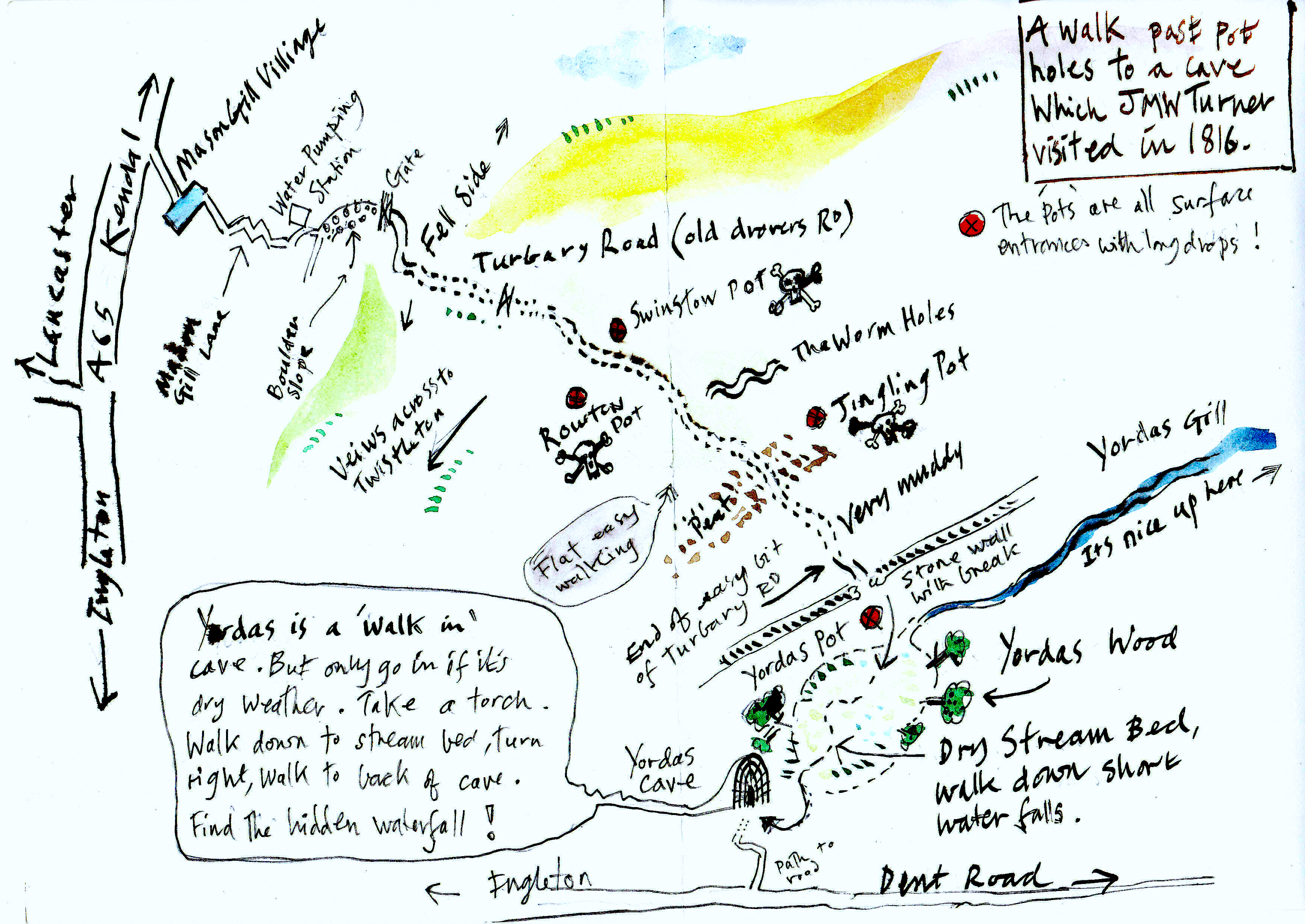
A walk past pot holes to a cave which J.M.W Turner visited in 1816.
A walk past pot holes to a cave which J.M.W Turner visited in 1816.
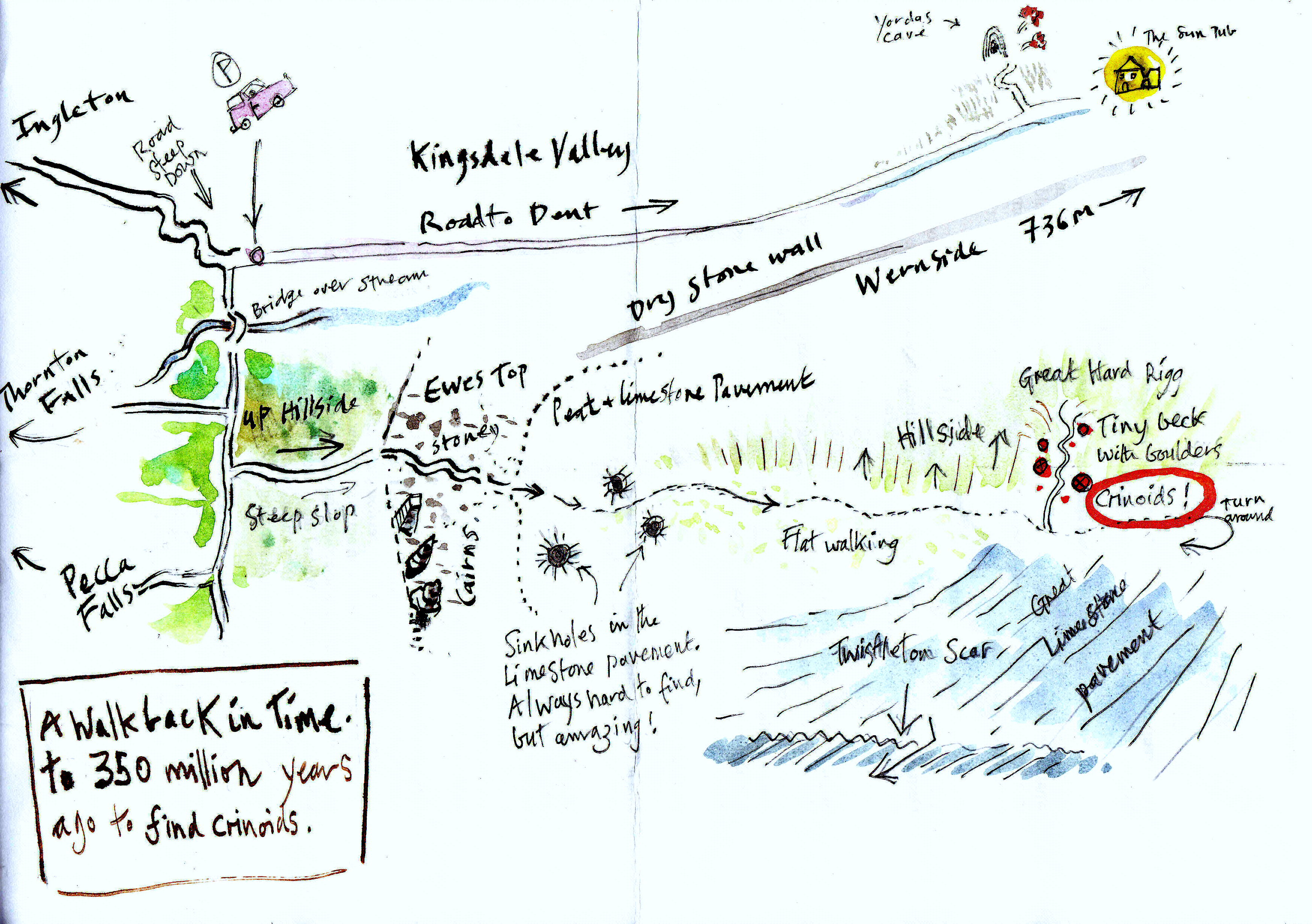
A walk back in time to 350 million years ago to find crinoids.
A walk back in time to 350 million years ago to find crinoids.
Gerry Davis, 12 May 2020.
Gerry Davis, 12 May 2020.
Cathy Turner
Cathy Turner
Fen End Walk: A Child's Dreamscape
Memory-map, words and photographs contributed during Walks to Remember During a Pandemic, April 2020.
Cathy Turner's memory-map revisits the landscape surrounding her childhood home. Blending remembered places with imagination, family memory and play, the walk evokes a landscape transformed by stories, seasonal rituals and the imaginative worlds of childhood.
Cathy Turner
Fen End Walk: A Child's Dreamscape
Memory-map, words and photographs contributed during Walks to Remember During a Pandemic, April 2020.
Cathy Turner's memory-map revisits the landscape surrounding her childhood home. Blending remembered places with imagination, family memory and play, the walk evokes a landscape transformed by stories, seasonal rituals and the imaginative worlds of childhood.
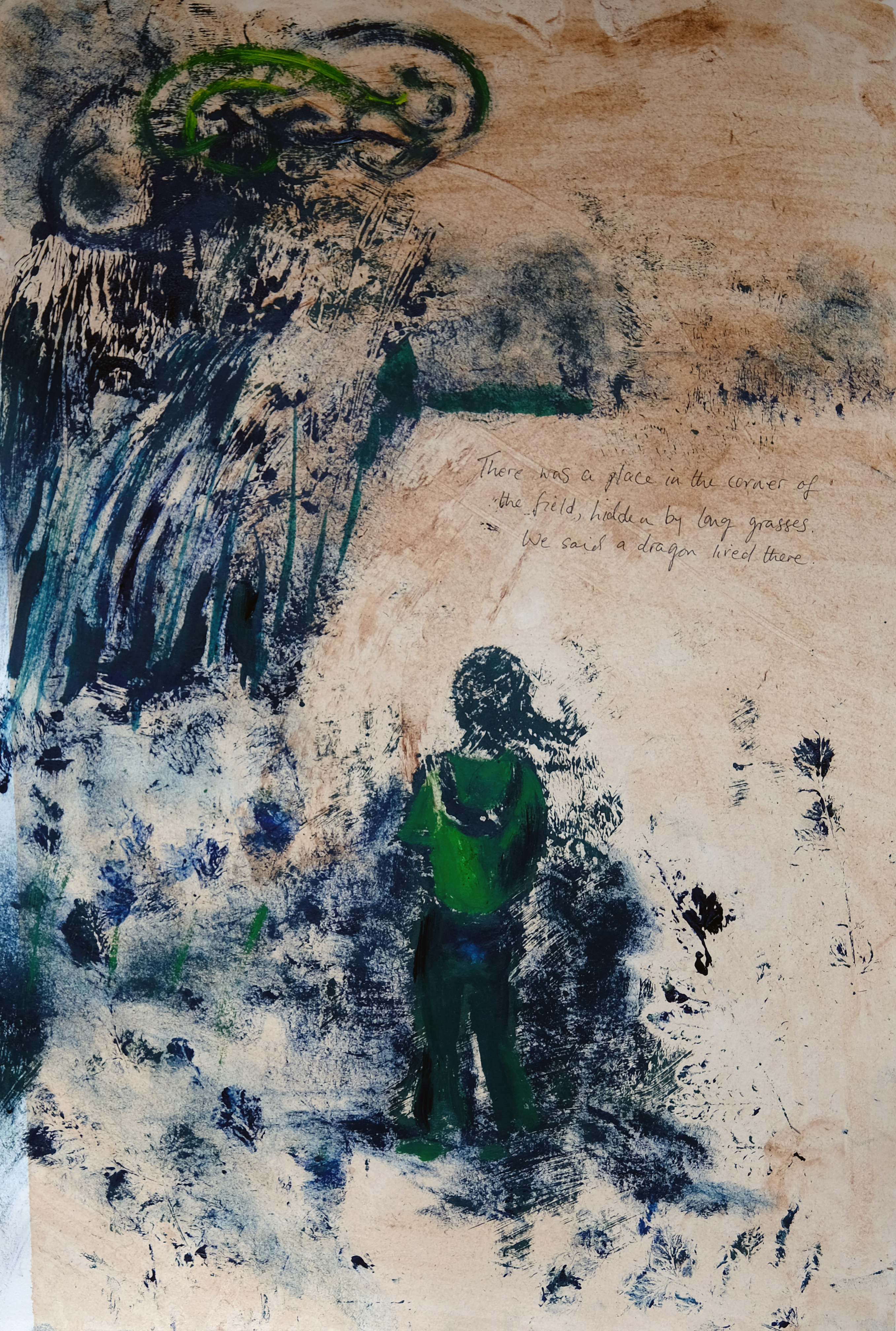
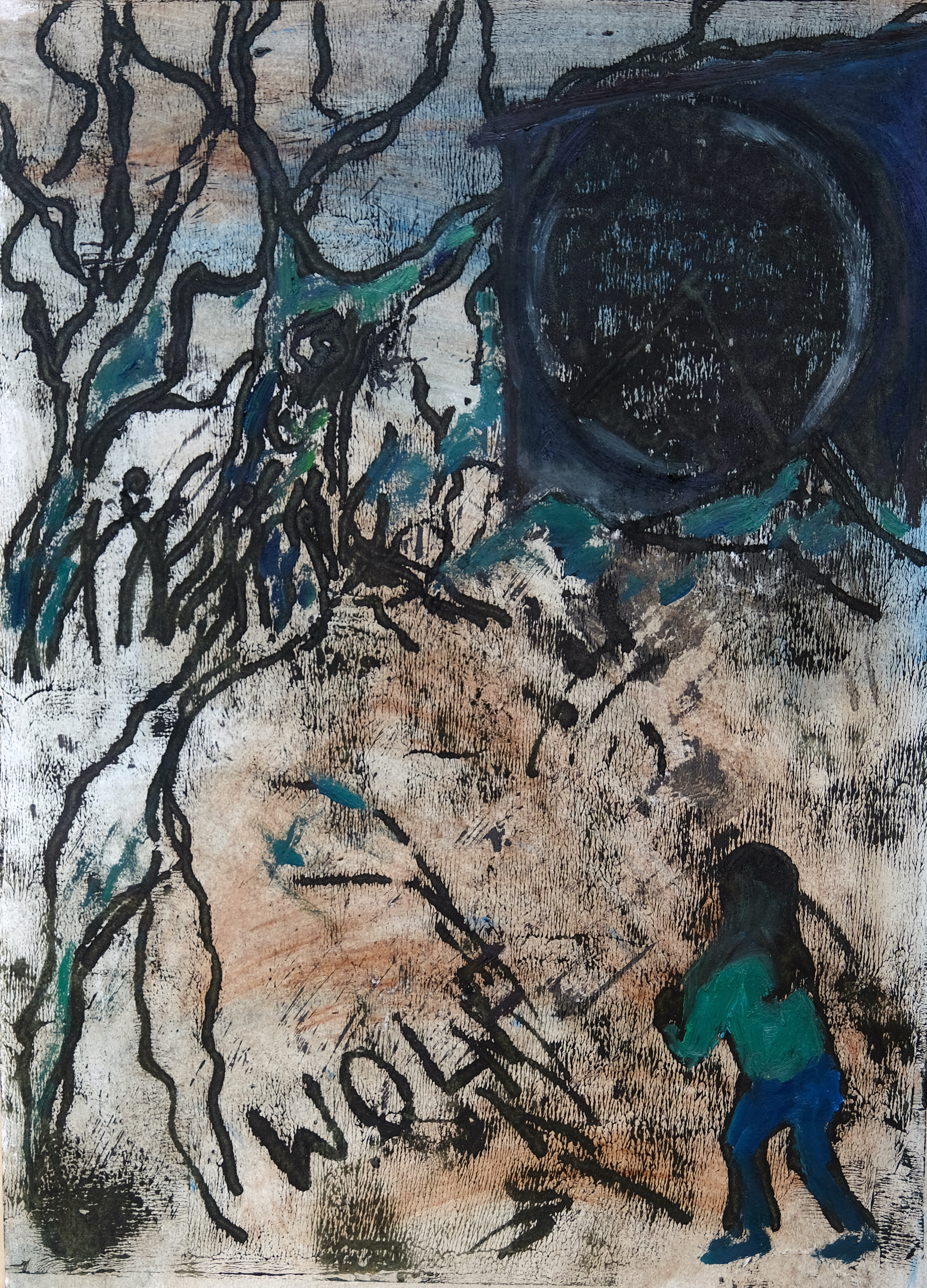
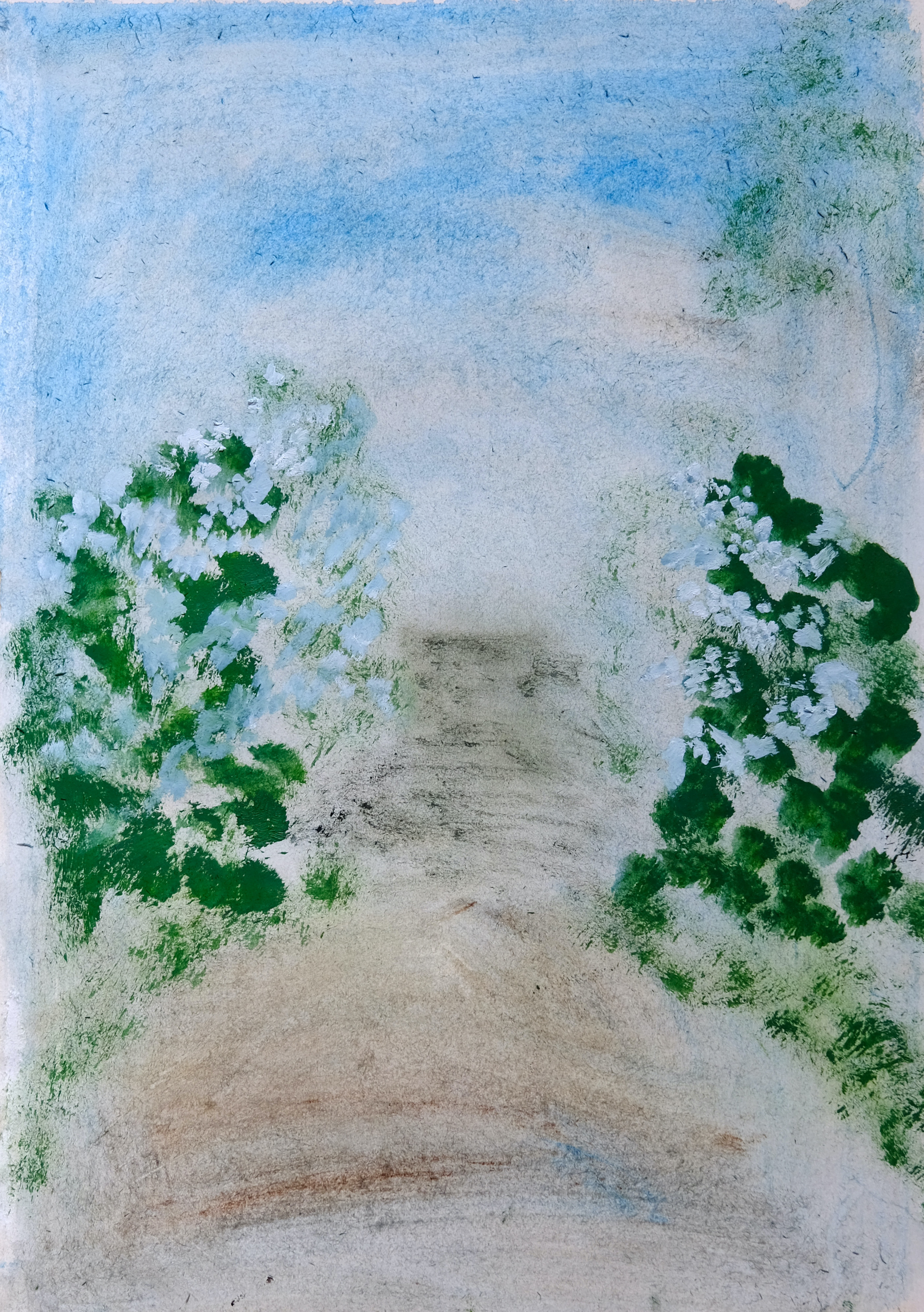
This remembered walk moves between three stopping points in the landscape around my childhood home. We played outside a lot, so that the corner of the field or the grain silo on the edge of Frogmore wood became inhabited by wolves, dragons or jokes. These two stops are solitary, perhaps during the 1970s (I gave myself flares). For the blossom, I’m with my mother, as she used to quote T.S. Eliot ‘If you came this way in maytime…’, whenever the hawthorn was out. The photographs show younger children, but the same landscape, and I’m looking into the ditch as though caught in conversation with my shadow.
This remembered walk moves between three stopping points in the landscape around my childhood home. We played outside a lot, so that the corner of the field or the grain silo on the edge of Frogmore wood became inhabited by wolves, dragons or jokes. These two stops are solitary, perhaps during the 1970s (I gave myself flares). For the blossom, I’m with my mother, as she used to quote T.S. Eliot ‘If you came this way in maytime…’, whenever the hawthorn was out. The photographs show younger children, but the same landscape, and I’m looking into the ditch as though caught in conversation with my shadow.
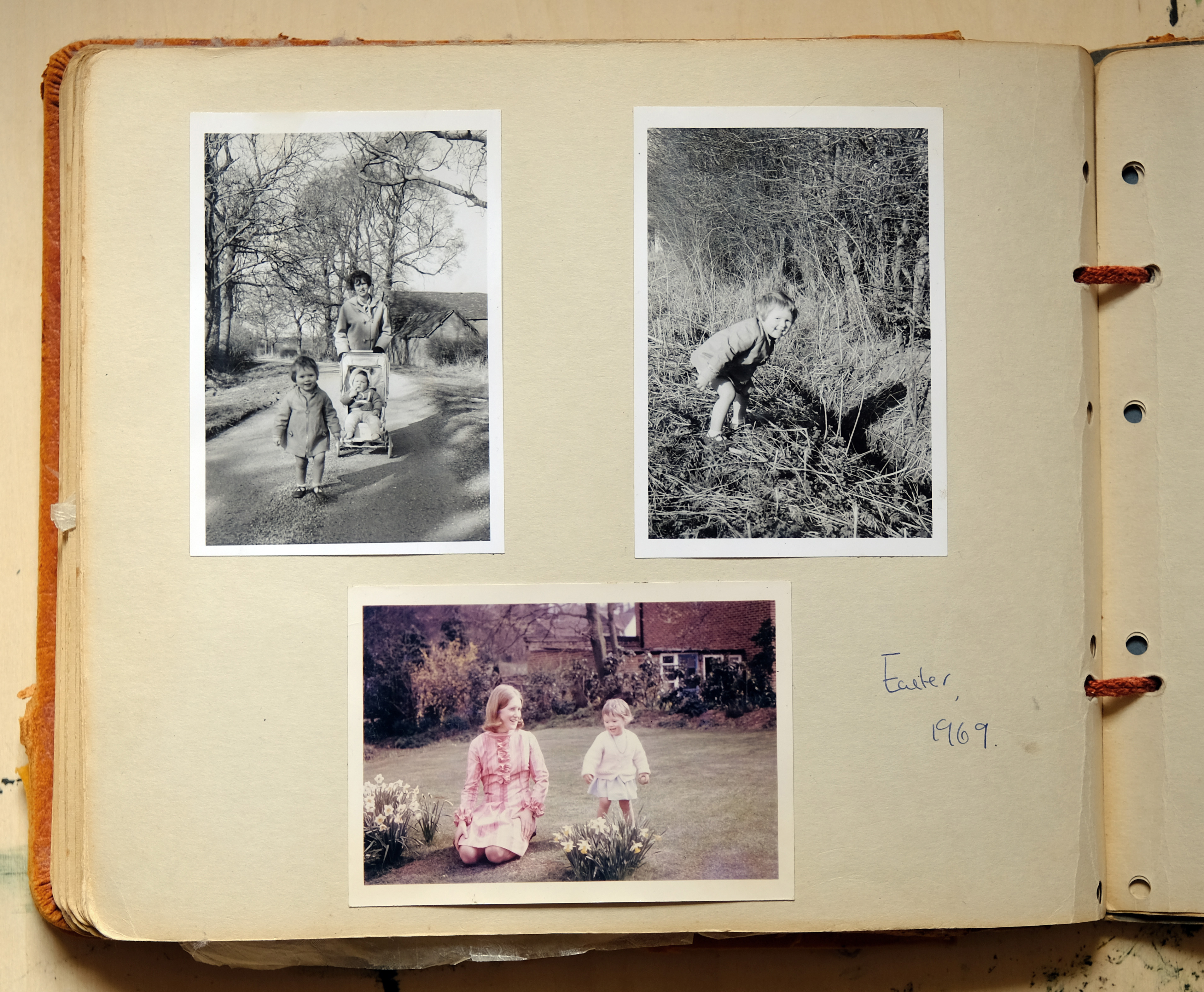
Cathy Turner, 4 April 2020.
Cathy Turner, 4 April 2020.
Clare Qualmann
Clare Qualmann
Walk from Breezy: "This Is the First Easter for 35 Years That I Have Not Been There!"
Memory-map, words and photographs contributed during Walks to Remember During a Pandemic, April 2020.
Clare Qualmann's memory-map retraces a familiar walk between Breezy on the Towans and the town of Hayle, Cornwall. Repeated over many years, the route is remembered through its rhythms, changing seasons, distinctive smells and the routines of everyday walking, revealing the deep attachment that can develop through returning to the same landscape.
Clare Qualmann
Walk from Breezy: "This Is the First Easter for 35 Years That I Have Not Been There!"
Memory-map, words and photographs contributed during Walks to Remember During a Pandemic, April 2020.
Clare Qualmann's memory-map retraces a familiar walk between Breezy on the Towans and the town of Hayle, Cornwall. Repeated over many years, the route is remembered through its rhythms, changing seasons, distinctive smells and the routines of everyday walking, revealing the deep attachment that can develop through returning to the same landscape.
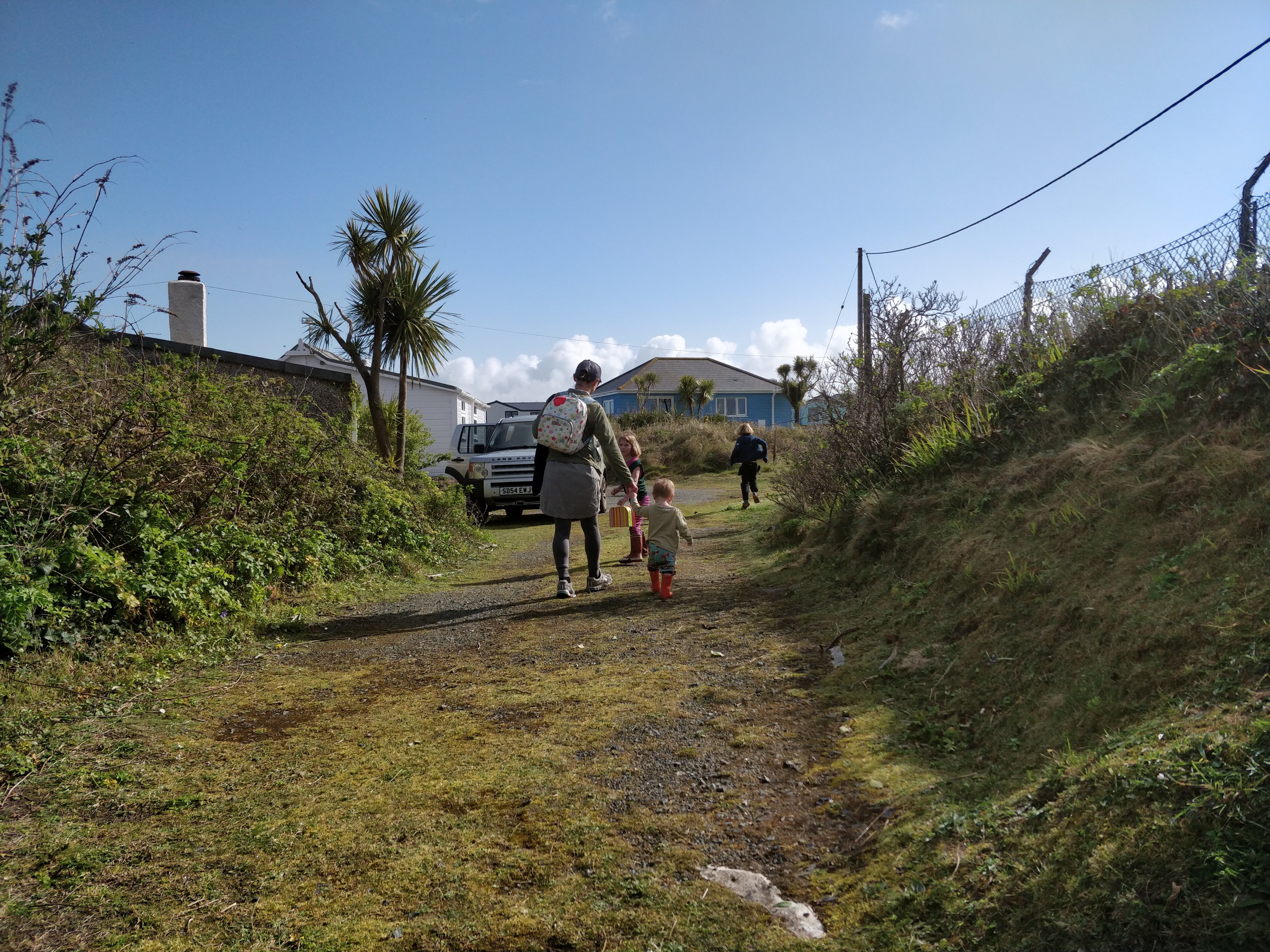
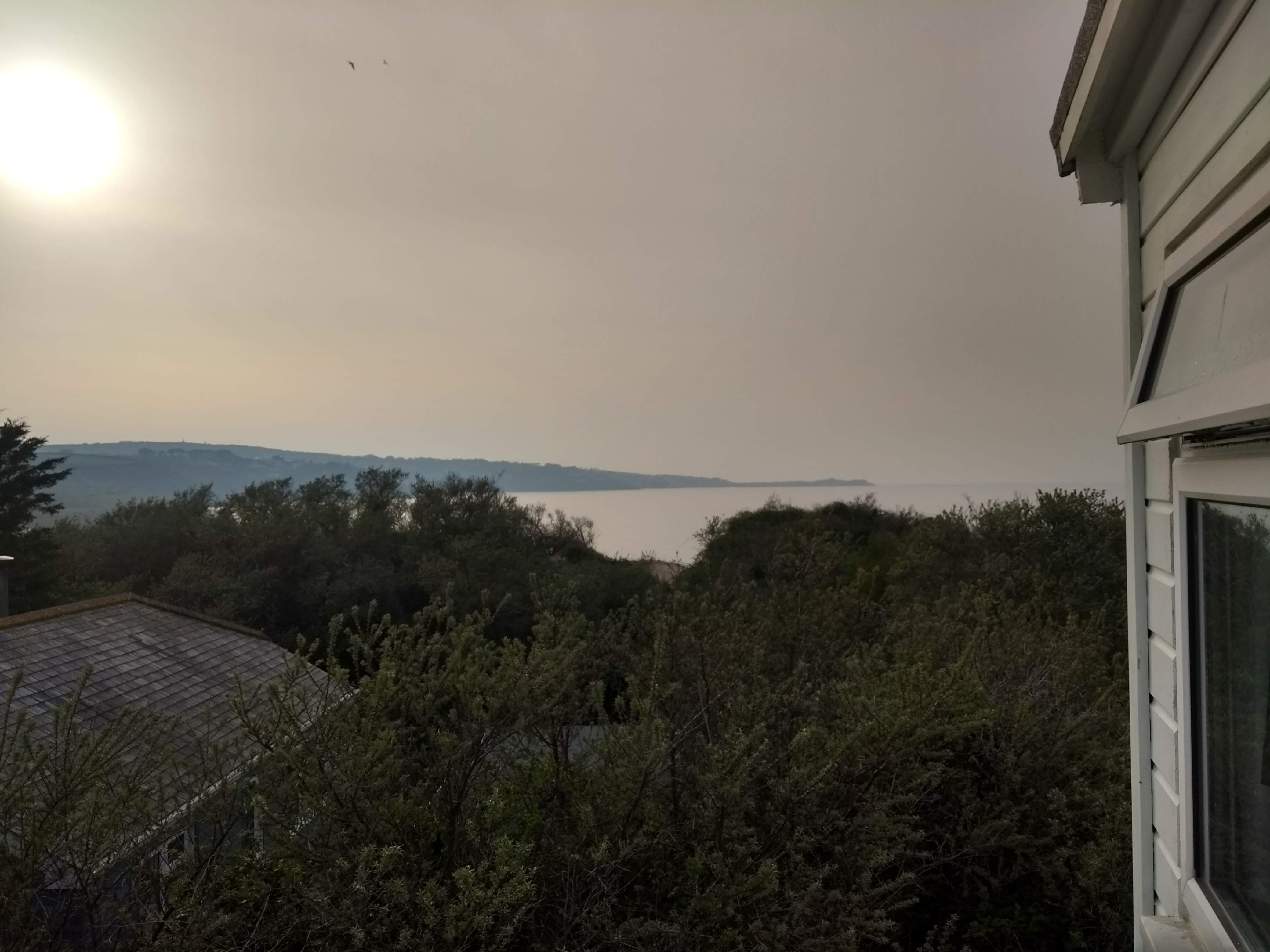
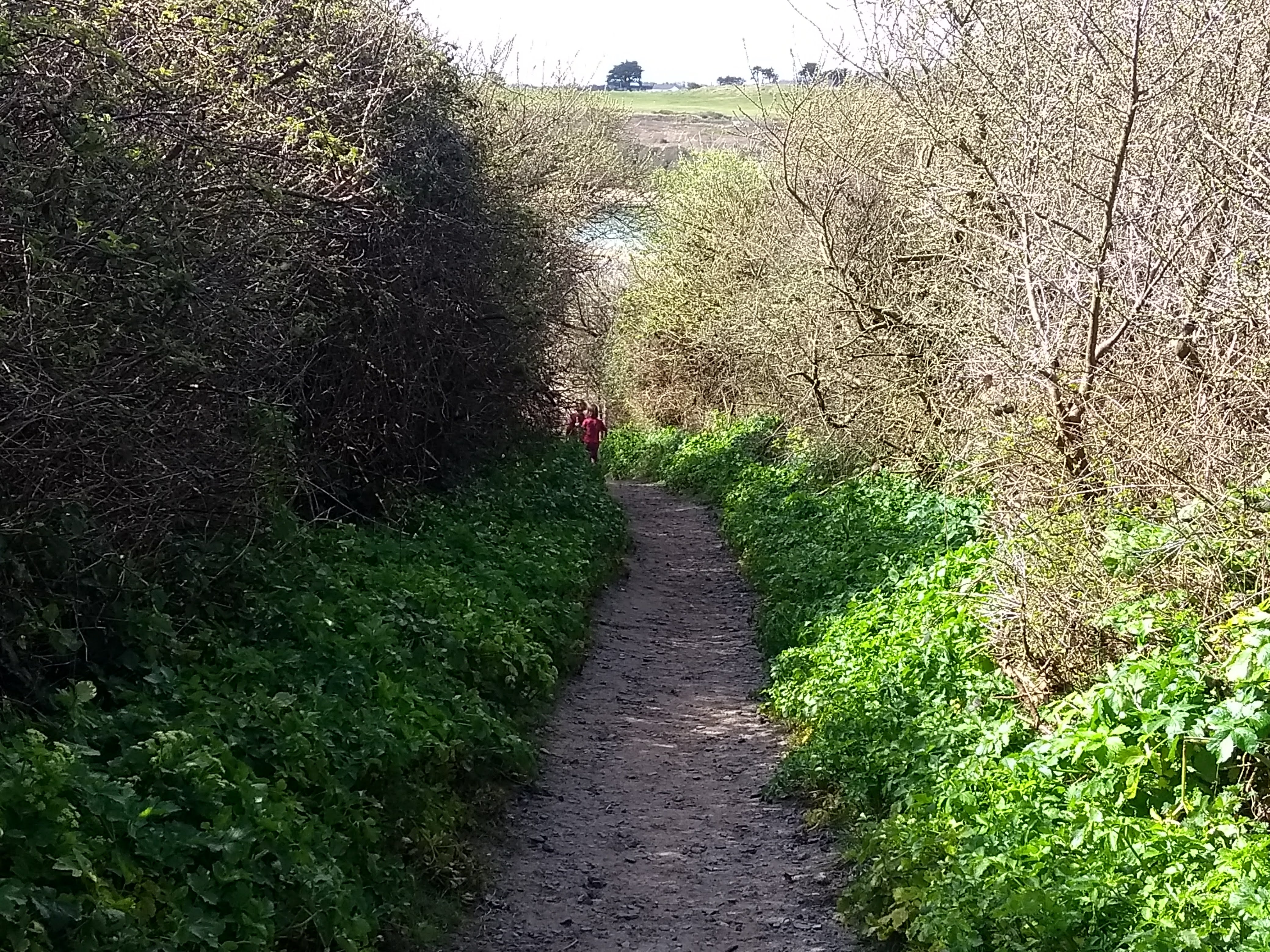
I have been staying at Breezy for about 15 years, but before that I stayed in a different chalet with my family, and before that in the caravan park next door (this is the first Easter for 35 years that I have not been there!). The walk has only been really regular for the 15 years that I’ve been staying at Breezy. We usually go without a car to Cornwall – we get a taxi out to the Towans when we arrive, and then we walk into Hayle for shopping etc. or to get the bus for trips into St Ives or Penzance.
The walk begins at Breezy, a chalet that’s right on the edge of the Towans, perched up high so there’s a 300 degree view of St Ives bay and the estuary. There’s a narrow path that leads down to the coastal path, and curves around following the estuary into Hayle. After the harbour you turn left and follow the estuary inland along King George V memorial walk – a super sheltered tropically planted path. The return route is up the very steep Phillack Hill, into the hamlet of Phillack, then across the dunes to the coast path, rejoining it by the Haven caravan park. You follow the coast path back past the cove and the Bluff pub to Breezy.
If we go as a family then it’s a good half day’s outing, but more often it’s a solo walk that’s done as a shopping mission, the return with a heavy backpack, but a pleasure to go off and move quickly. The smell of the cauliflower fields are often distinctive on the way back, and the coconut gorse blossom if it’s sunny on the dunes. If it’s wet it’s hard to avoid crunching a snail or two, and the distinctive sound of their poor shells cracking.
I have been staying at Breezy for about 15 years, but before that I stayed in a different chalet with my family, and before that in the caravan park next door (this is the first Easter for 35 years that I have not been there!). The walk has only been really regular for the 15 years that I’ve been staying at Breezy. We usually go without a car to Cornwall – we get a taxi out to the Towans when we arrive, and then we walk into Hayle for shopping etc. or to get the bus for trips into St Ives or Penzance.
The walk begins at Breezy, a chalet that’s right on the edge of the Towans, perched up high so there’s a 300 degree view of St Ives bay and the estuary. There’s a narrow path that leads down to the coastal path, and curves around following the estuary into Hayle. After the harbour you turn left and follow the estuary inland along King George V memorial walk – a super sheltered tropically planted path. The return route is up the very steep Phillack Hill, into the hamlet of Phillack, then across the dunes to the coast path, rejoining it by the Haven caravan park. You follow the coast path back past the cove and the Bluff pub to Breezy.
If we go as a family then it’s a good half day’s outing, but more often it’s a solo walk that’s done as a shopping mission, the return with a heavy backpack, but a pleasure to go off and move quickly. The smell of the cauliflower fields are often distinctive on the way back, and the coconut gorse blossom if it’s sunny on the dunes. If it’s wet it’s hard to avoid crunching a snail or two, and the distinctive sound of their poor shells cracking.
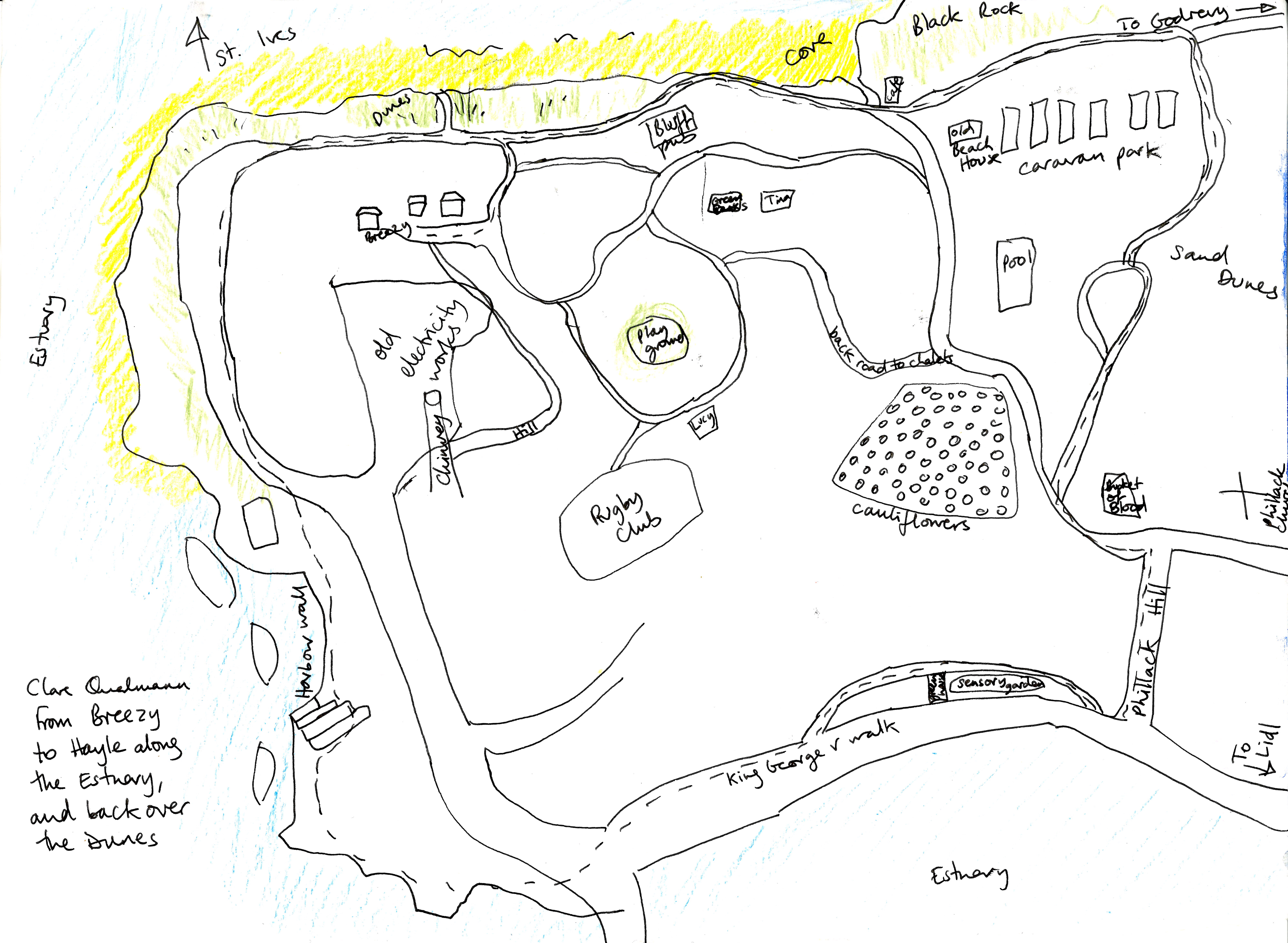
Clare Qualmann, 16 April 2020.
Clare Qualmann, 16 April 2020.
Godfrey Wilson
Godfrey Wilson
Circular Walk from Isles Cottages to Summer Lodge Tarn, Swaledale
"This One Is My Favourite"
Memory-map, words and photographs contributed during Walks to Remember During a Pandemic, April 2020.
Godfrey Wilson's memory-map retraces a favourite circular walk through Upper Swaledale. Rich in observations of wildlife, farming, rivers and the remains of lead mining, the remembered walk reflects a deep familiarity with the landscape developed over twenty years of living in the dale.
Godfrey Wilson
Circular Walk from Isles Cottages to Summer Lodge Tarn, Swaledale
"This One Is My Favourite"
Memory-map, words and photographs contributed during Walks to Remember During a Pandemic, April 2020.
Godfrey Wilson's memory-map retraces a favourite circular walk through Upper Swaledale. Rich in observations of wildlife, farming, rivers and the remains of lead mining, the remembered walk reflects a deep familiarity with the landscape developed over twenty years of living in the dale.
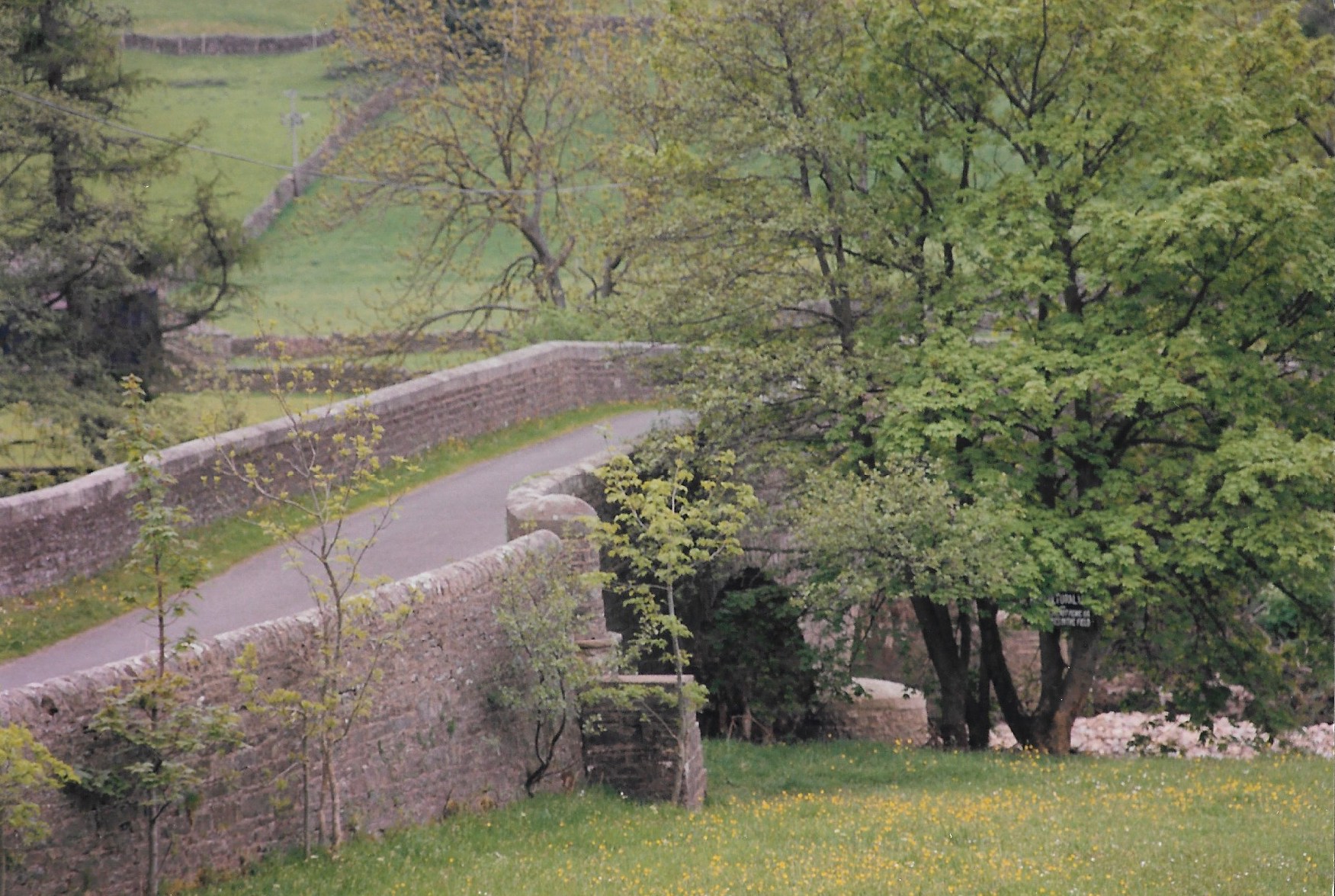
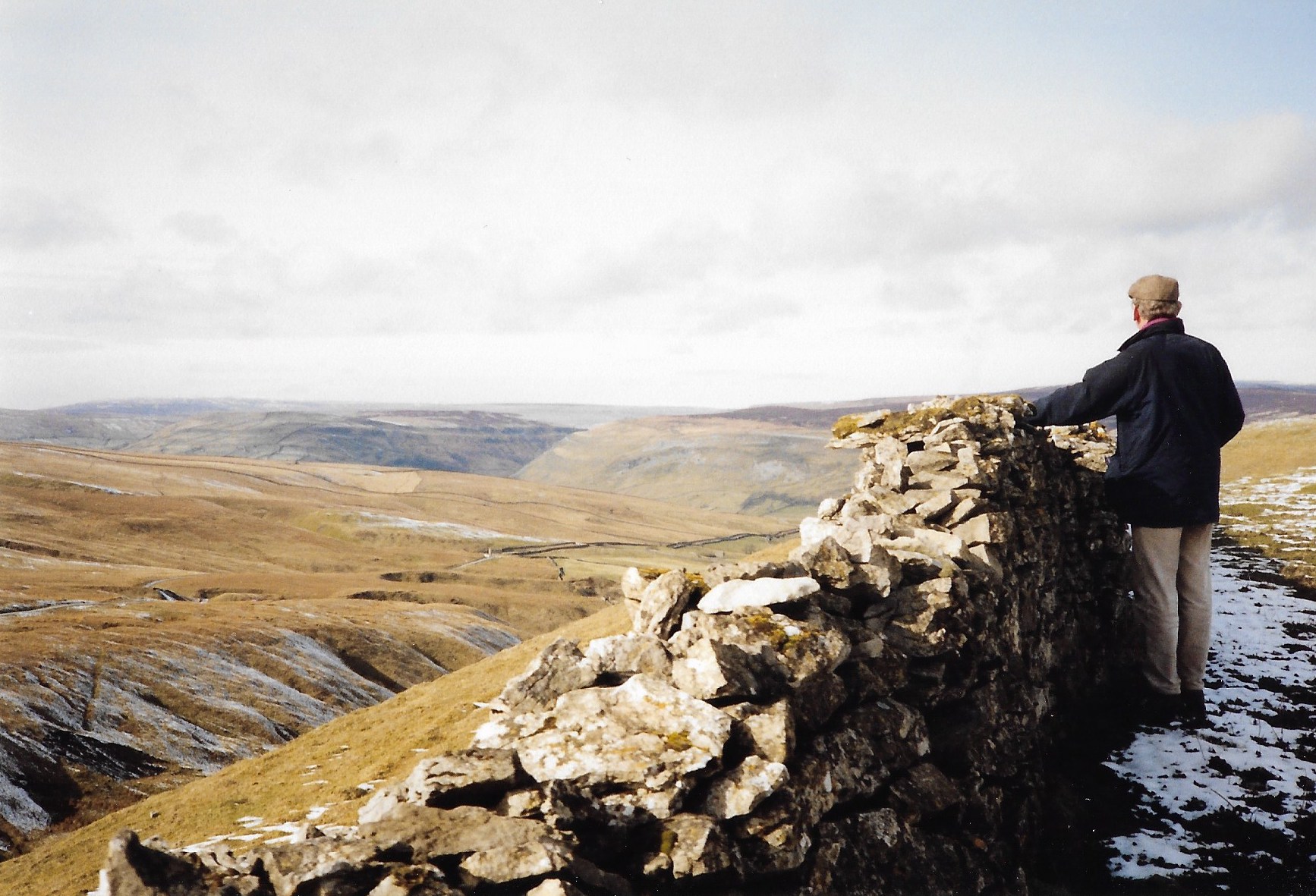
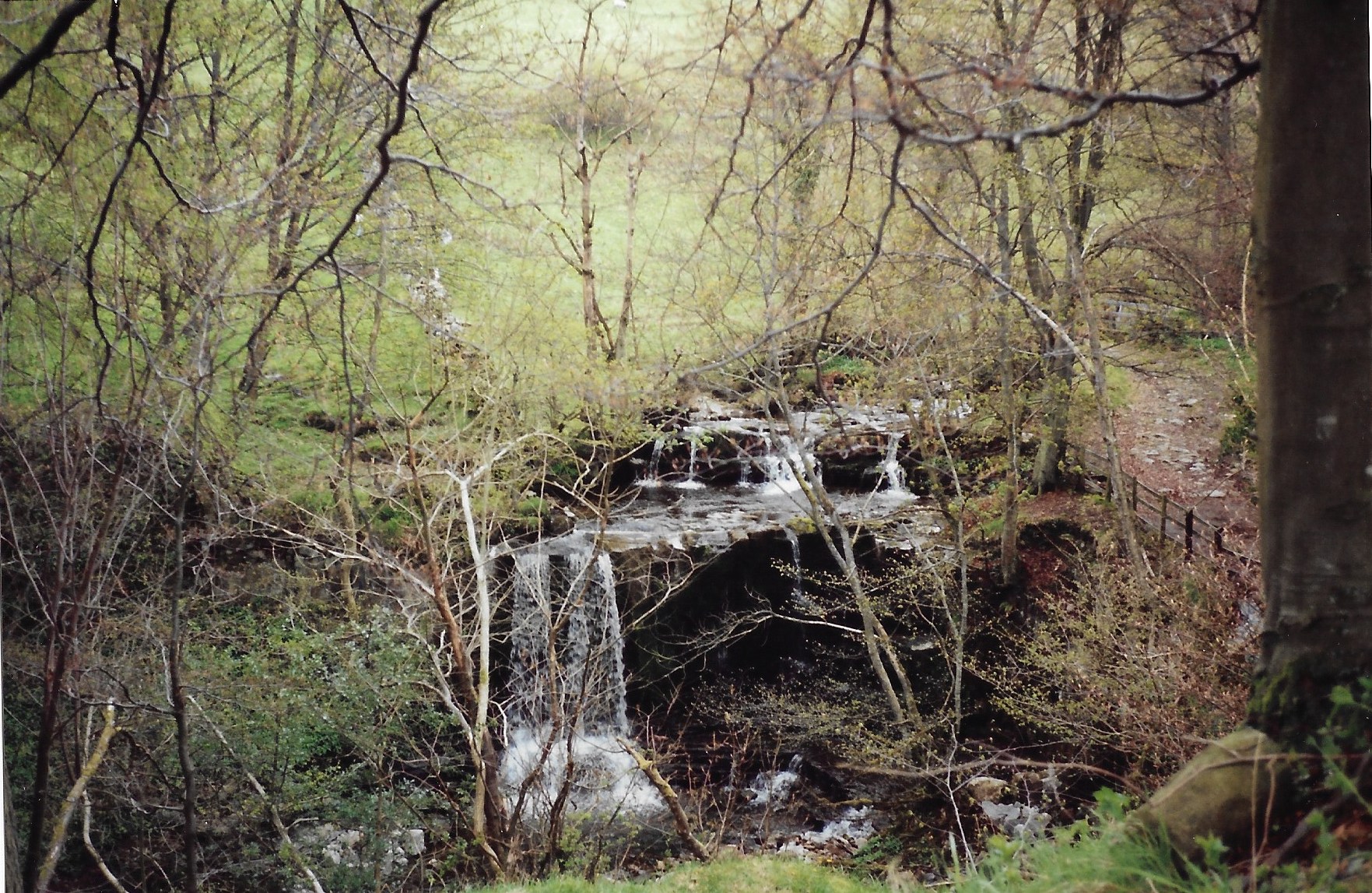
Having the great good fortune to live in Swaledale for twenty years I was able to enjoy many wonderful walks. This one is my favourite.
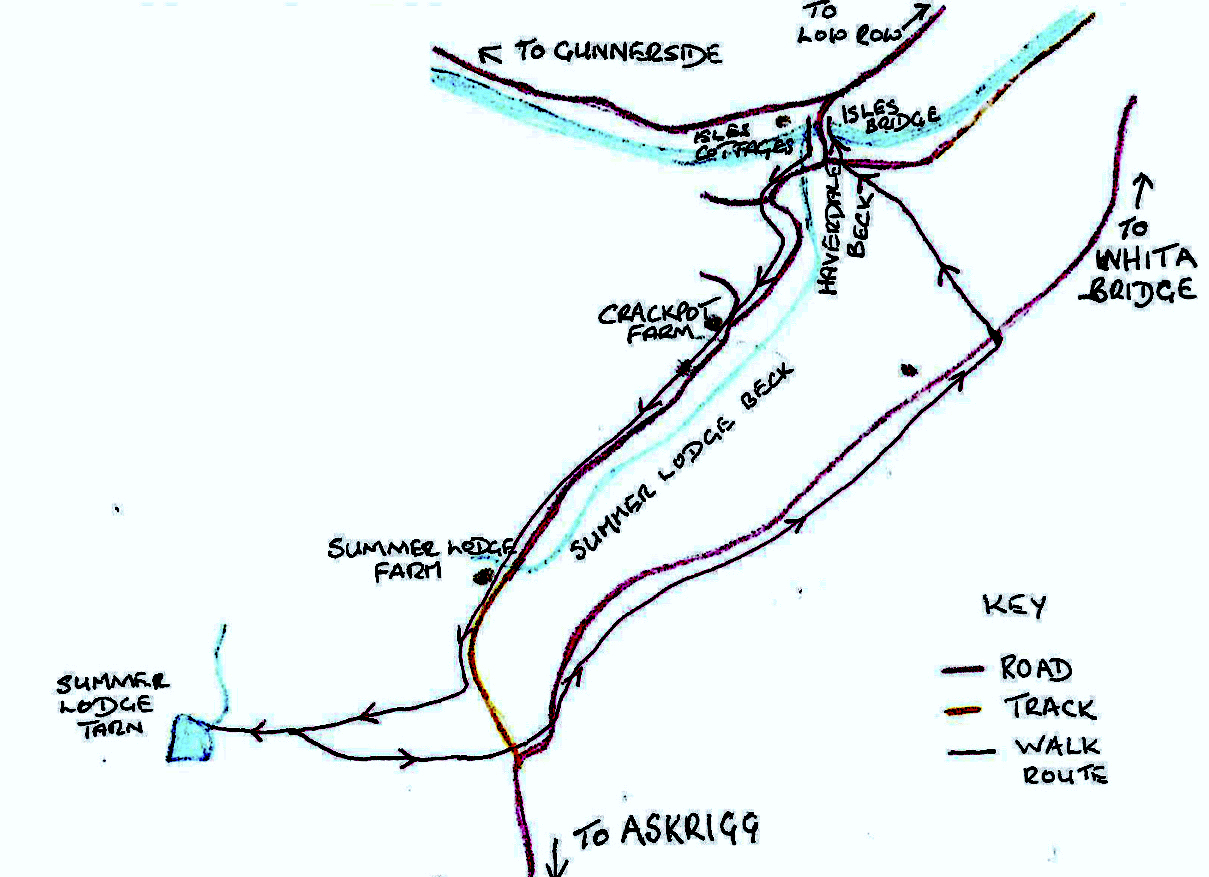
Heading south from Isles Cottages I cross Isles Bridge. The River Swale rushes beneath. I catch a flash of blue as a Kingfisher flies for cover. Upstream, Sand Martins dash in and out of small holes in the river bank and Oyster Catchers circle and call above their nesting area.
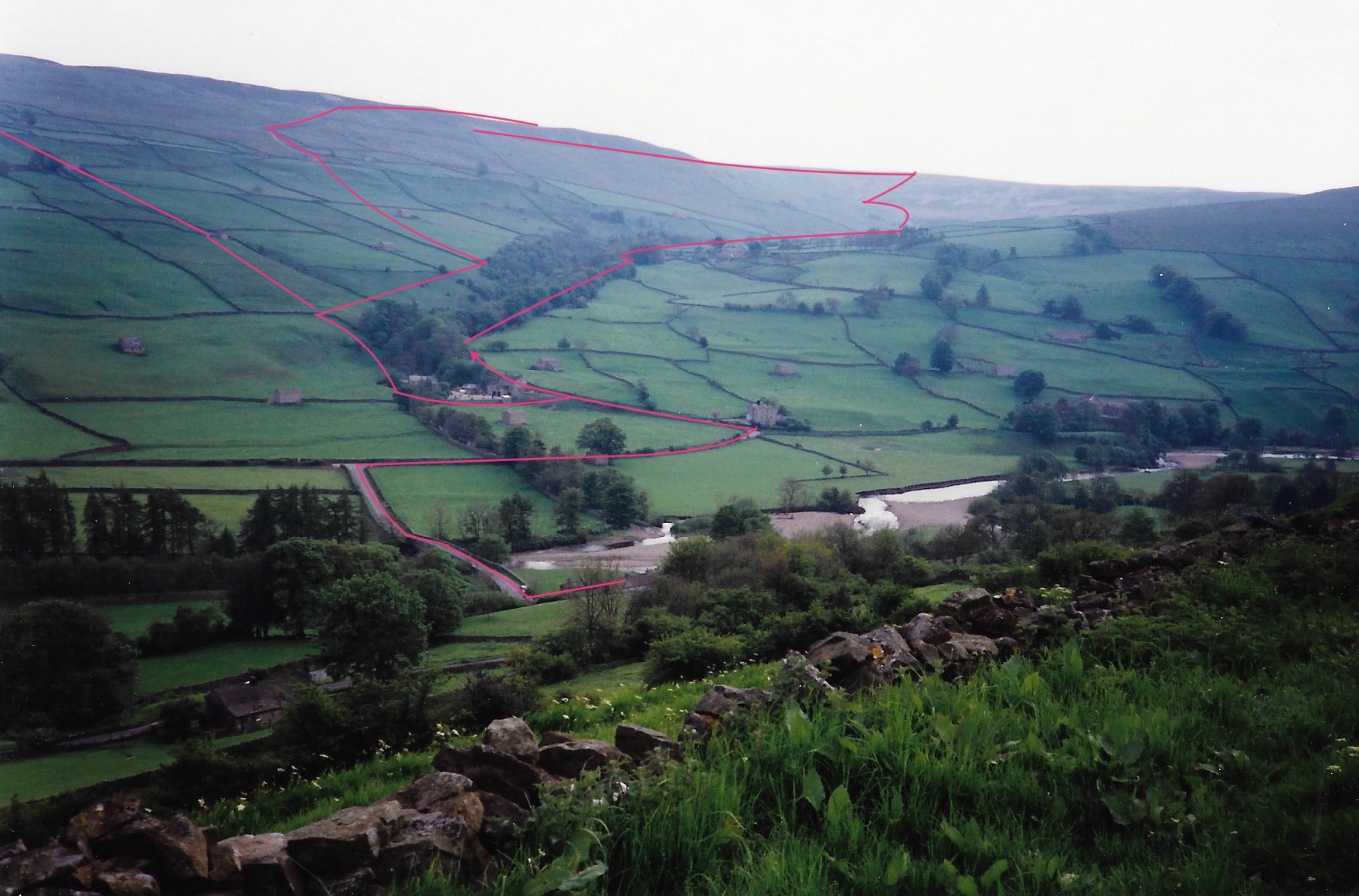
Moving on, there are meadows to the left and right of the drystone walls. At the T-junction I turn right and cross Haverdale Beck Bridge before beginning the climb up to Crackpot. If time allows, I make a short detour down a track to beautiful waterfalls. It is so peaceful here there is a strong temptation to linger. Returning to the road I enjoy the primroses growing on both banks. At the top I arrive at the tiny hamlet of Crackpot. The road is level now, I move on appreciating the wild flowers. If I am lucky, a curlew will fly above me plaintively calling before gliding down to the moor beyond. Sheep graze and lambs play in the meadows. In the valley below runs Summer Lodge Beck. This valley seems like an undiscovered place to me. I reach the Summer Lodge Farm, children are playing in the garden their voices echoing from the sides of the hill. Now I enter open moorland and climb higher amongst ruined buildings associated with lead mining activity at Crackpot Mine. I head west. Easy walking now so my pace quickens. Reaching Summer Lodge Tarn there is a cacophony of sound as the black headed gulls swirl above the tarn and my head. The breeze ripples the water and I imagine I am on top of the world.
It’s time to move on as the breeze is beginning to chill me. I retrace my steps along the track heading east to join the road from Askrigg to Low Whita Bridge. On my right rises Whitaside Moor and to my left the view of Summer Lodge Valley is spectacular. Soon my view of the valley is blocked by a high drystone wall. When the wall stops and the valley below is revealed the temptation to stop and savour the view is great. The River Swale makes its way through trees and meadows separated by dry stone walls, many contain a stone barn. I descend through the fields seeking a tiny wooden hinged gate. Walking beside Haverdale Beck, I leave the path and join the road that will take me back to the cottages, and home.
Having the great good fortune to live in Swaledale for twenty years I was able to enjoy many wonderful walks. This one is my favourite.
Heading south from Isles Cottages I cross Isles Bridge. The River Swale rushes beneath. I catch a flash of blue as a Kingfisher flies for cover. Upstream, Sand Martins dash in and out of small holes in the river bank and Oyster Catchers circle and call above their nesting area.
Moving on, there are meadows to the left and right of the drystone walls. At the T-junction I turn right and cross Haverdale Beck Bridge before beginning the climb up to Crackpot. If time allows, I make a short detour down a track to beautiful waterfalls. It is so peaceful here there is a strong temptation to linger. Returning to the road I enjoy the primroses growing on both banks. At the top I arrive at the tiny hamlet of Crackpot. The road is level now, I move on appreciating the wild flowers. If I am lucky, a curlew will fly above me plaintively calling before gliding down to the moor beyond. Sheep graze and lambs play in the meadows. In the valley below runs Summer Lodge Beck. This valley seems like an undiscovered place to me. I reach the Summer Lodge Farm, children are playing in the garden their voices echoing from the sides of the hill. Now I enter open moorland and climb higher amongst ruined buildings associated with lead mining activity at Crackpot Mine. I head west. Easy walking now so my pace quickens. Reaching Summer Lodge Tarn there is a cacophony of sound as the black headed gulls swirl above the tarn and my head. The breeze ripples the water and I imagine I am on top of the world.
It’s time to move on as the breeze is beginning to chill me. I retrace my steps along the track heading east to join the road from Askrigg to Low Whita Bridge. On my right rises Whitaside Moor and to my left the view of Summer Lodge Valley is spectacular. Soon my view of the valley is blocked by a high drystone wall. When the wall stops and the valley below is revealed the temptation to stop and savour the view is great. The River Swale makes its way through trees and meadows separated by dry stone walls, many contain a stone barn. I descend through the fields seeking a tiny wooden hinged gate. Walking beside Haverdale Beck, I leave the path and join the road that will take me back to the cottages, and home.
Godfrey M. Wilson, 28 April 2020.
Godfrey M. Wilson, 28 April 2020.
Morag Paterson
Morag Paterson
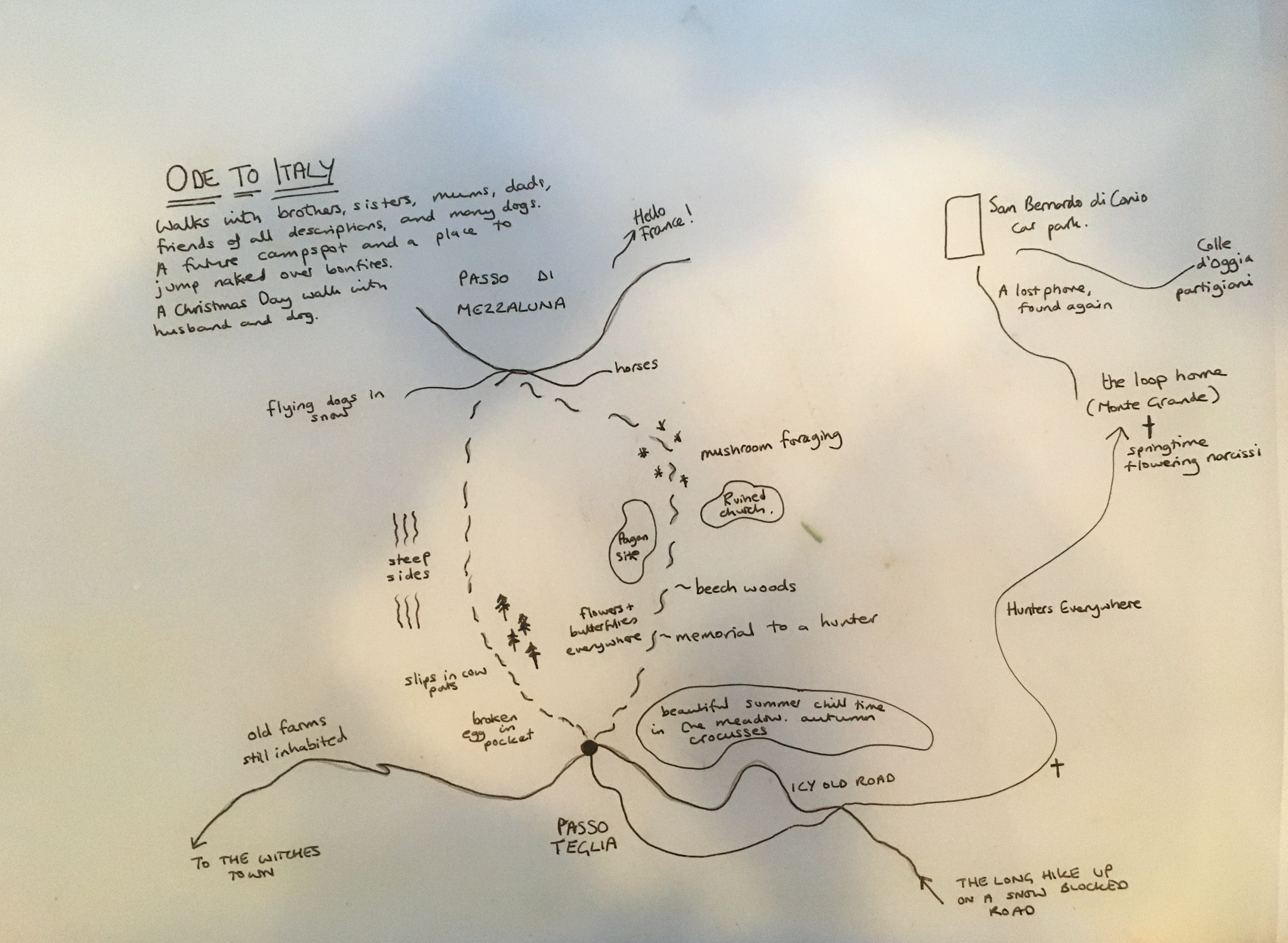
Mezzaluna with Sophie Walk: "An Ode to Italy"
Memory-map, words and photographs contributed during Walks to Remember During a Pandemic, March 2020.
Morag Paterson's memory-map returns to a favourite walk in the Ligurian mountains of northern Italy. Remembered from Scotland during the first Covid-19 lockdown, the walk reflects a longing to return to a familiar landscape of mountain passes, expansive views, rich wildlife and shared experiences with family and friends.
Morag Paterson
Mezzaluna with Sophie Walk: "An Ode to Italy"
Memory-map, words and photographs contributed during Walks to Remember During a Pandemic, March 2020.
Morag Paterson's memory-map returns to a favourite walk in the Ligurian mountains of northern Italy. Remembered from Scotland during the first Covid-19 lockdown, the walk reflects a longing to return to a familiar landscape of mountain passes, expansive views, rich wildlife and shared experiences with family and friends.
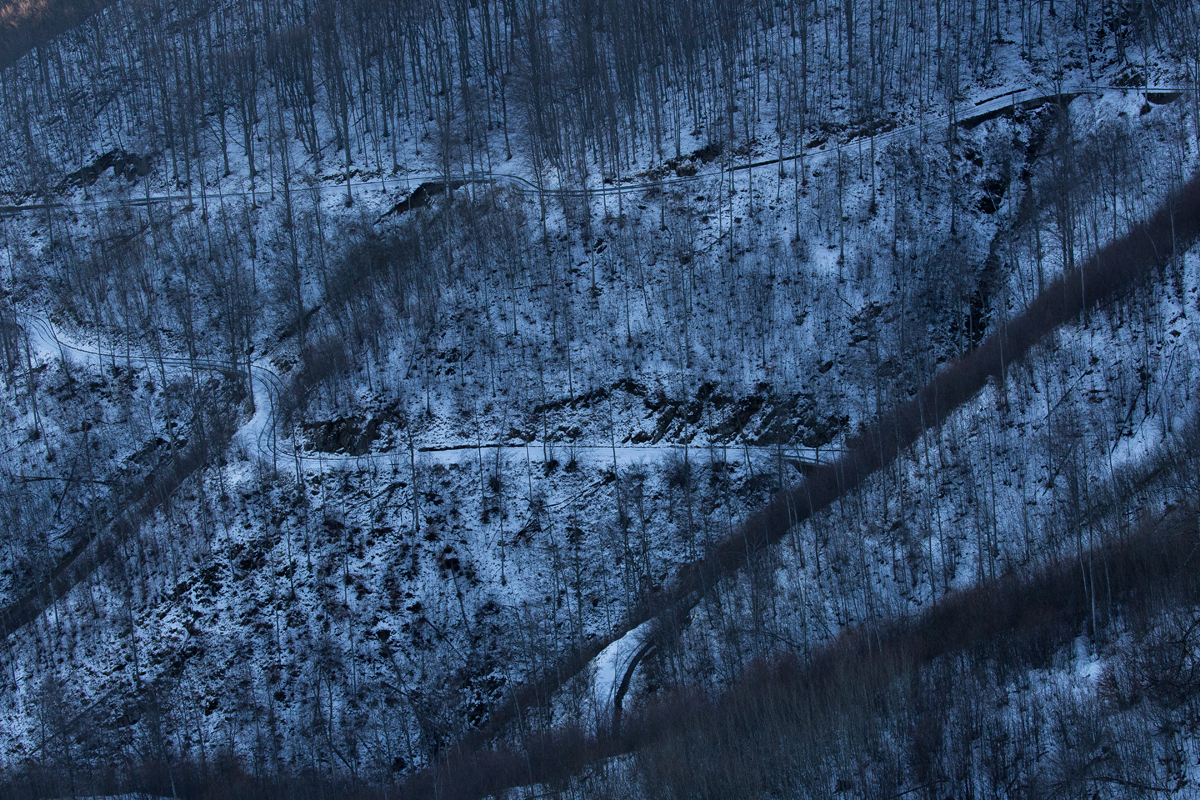
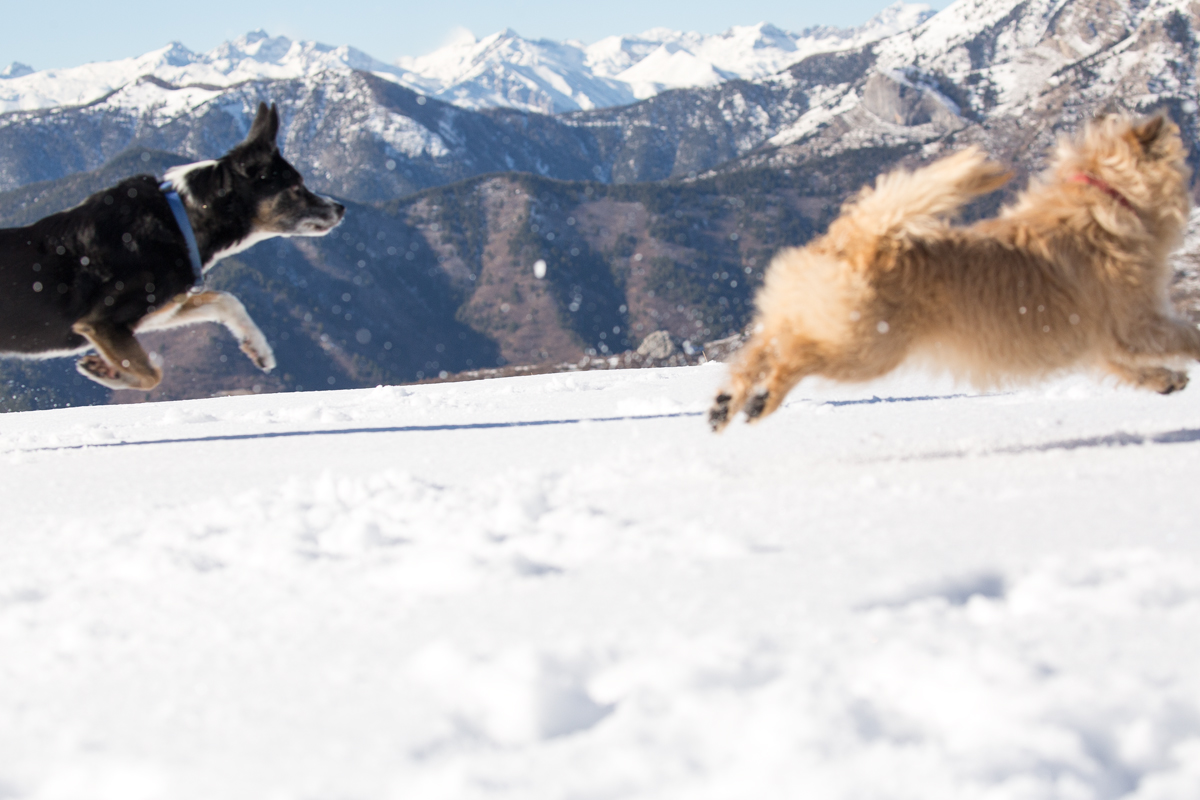
An Ode To Italy is a conglomeration of walks already walked, a walk I would very much like to be repeating in the spring of 2020 yet am unable to (we live between Scotland and Italy and were in Scotland when the Coronavirus outbreak became a problem there).
It’s called Passo Teglia to Passo di Mezzaluna (Half Moon Pass), a walk I can either drive to the start of with those less able, or take a full day to walk to from our house. We’ve taken nearly all our visitors there, it’s accessible, and sheltered even at the height of 1300m.
The views are incredible, to the sea in the south and France in the west. Flora and fauna abound, there’s great foraging, and the potential for spotting a wolf.
An Ode To Italy is a conglomeration of walks already walked, a walk I would very much like to be repeating in the spring of 2020 yet am unable to (we live between Scotland and Italy and were in Scotland when the Coronavirus outbreak became a problem there).
It’s called Passo Teglia to Passo di Mezzaluna (Half Moon Pass), a walk I can either drive to the start of with those less able, or take a full day to walk to from our house. We’ve taken nearly all our visitors there, it’s accessible, and sheltered even at the height of 1300m.
The views are incredible, to the sea in the south and France in the west. Flora and fauna abound, there’s great foraging, and the potential for spotting a wolf.
Morag Paterson, 25 March 2020.
Morag Paterson, 25 March 2020.
Dierdre Heddon
Deirdre Heddon
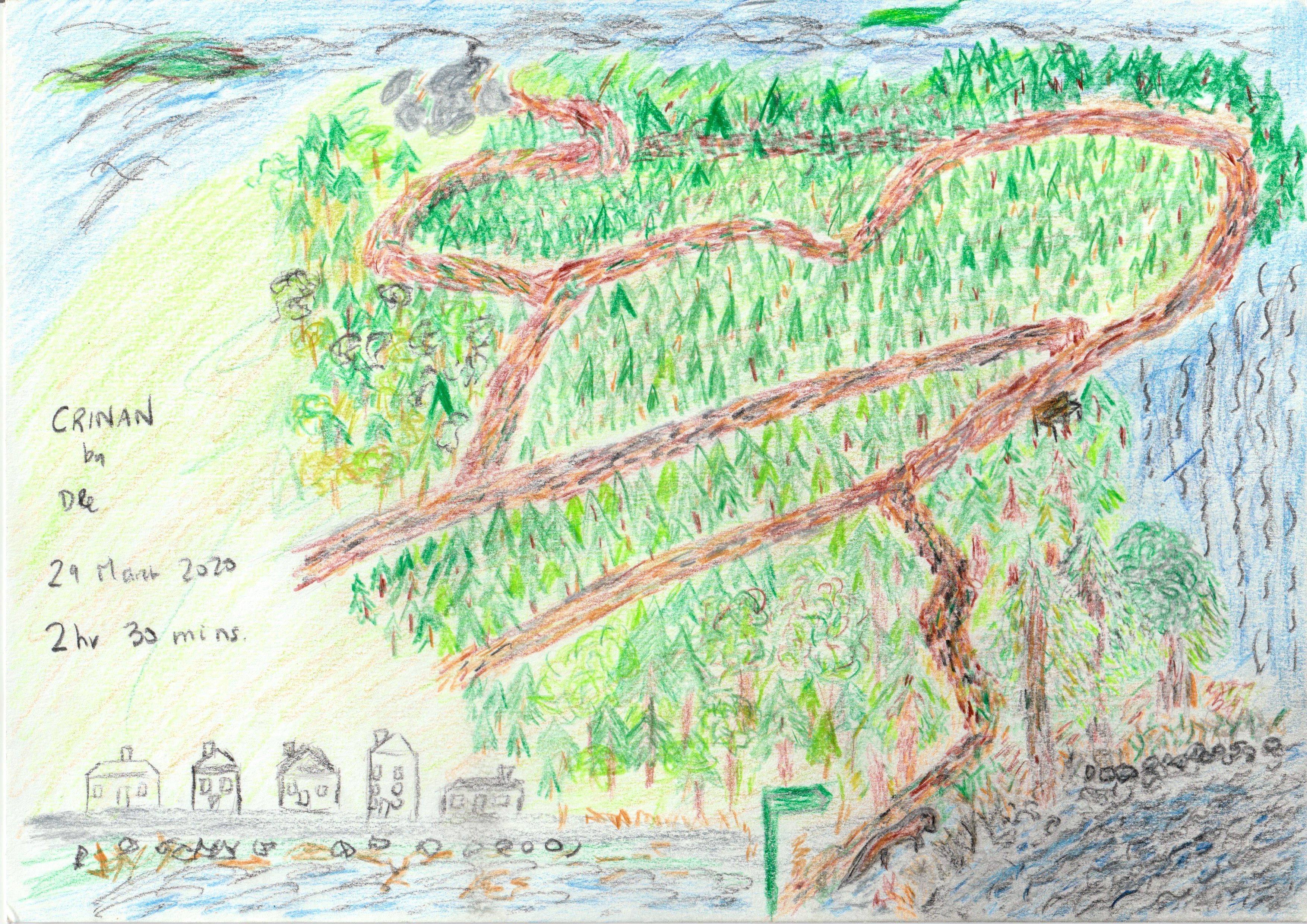
Crinan Walk
Memory-map contributed during Walks to Remember During a Pandemic, March 2020.
Deirdre Heddon's memory-map retraces a walk around Crinan on Scotland's west coast. Through a carefully drawn route and a series of remembered stopping places, the map invites the reader to follow the rhythms of a familiar walk and to imagine the landscape through memory.
Deirdre Heddon
Crinan Walk
Memory-map contributed during Walks to Remember During a Pandemic, March 2020.
Deirdre Heddon's memory-map retraces a walk around Crinan on Scotland's west coast. Through a carefully drawn route and a series of remembered stopping places, the map invites the reader to follow the rhythms of a familiar walk and to imagine the landscape through memory.
Deirdre Heddon, 29 March 2020
Deirdre Heddon, 29 March 2020